|
|
JUSTIN TANNER REVIEWS THE BLACK PHONE
There’s a scene near the beginning of director Scott Derrickson’s supernatural serial killer movie “The Black Phone,” where an alcoholic father (Jeremy Davies) savagely beats the crap out of his daughter (Madeleine McGraw) with a leather belt for what seems like hours. There’s no reason for the beating: we already know the dad is a creep. Nonetheless, it goes on and on ad nauseam, long past the point of acceptability as narrative device or mood setter, and into the realm of full-on grindhouse exploitation. In the process, those of us in the dumbfounded audience — those who don’t walk out immediately — become the unwitting voyeurs of what can only be described as “Child Abuse Porn.”
And the result of this sickening and unnecessary side trip — which has nothing relevant to add to the plot — is that the film, on shaky legs to begin with, is thrown irrevocably off course. Set in Denver in the mid 1970’s, “The Black Phone” tells the rather implausible story of a masked child murderer called “The Grabber” who (naturally) “grabs” young boys off the street, takes them to a subterranean basement and...feeds them scrambled eggs and Sprite. I assume he does other things too, but since we’re not given access to his abattoir (thank God) all we see of his villainy is a lame series of Snidely Whiplash mustache-twirling threats delivered in a stock unscary cartoon voice by a sadly off-target Ethan Hawke. And the dorky, impractical Scooby-Doo masks that he spends the whole movie hiding behind are neither frightening or convincing. They simply hide his very expressive face, which, considering the inexcusable lameness of it all, might not be such a bad idea.
The movie starts in slo-mo exposition mode, with twenty-plus minutes of slackly paced filler clogging up the pipes before a preteen named Finney (Mason Thames, trying his best) becomes Hawke’s latest abductee. And for the rest of the film, the director tries in vain to build tension around whether Finney will escape the basement or become Grabber meat. His survival is never in question; other than the child beating scene, Derrickson seems incapable of actual dread. Stephen King is known as a great storyteller. And he must be doing something right given his sales. But I’ve never been seduced by his ham-fisted mythology, his flaccid dialog, his mono-dimensional characters, his cringe-inducing sex scenes, or his operatic, rococo climaxes that strain credulity so profoundly they’re almost hallucinogenic. And I know Stephen King didn’t actually write “The Black Phone.” His son, Joe Hill did. But it’s definitely got King’s greasy cheeseburger chromosomes all over it:
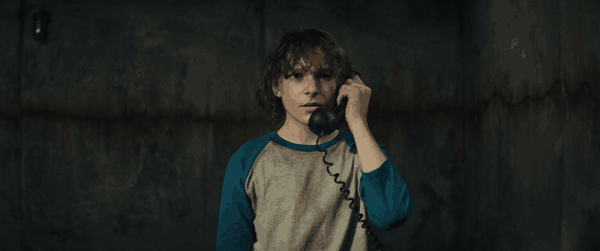
Most depressingly, the lazily constructed grab bag of speciously incoherent plot elements are all pure King. For instance: nobody can find “The Grabber,” even though his hunting ground is a three block radius. He drives a creepy-looking black van that might as well have ‘serial killer’ airbrushed on the side. He prances around the streets like Phantom of the Opera in a cape and top hat. Nothing suspicious here! Plus, his supposedly soundproof torture dungeon has a window in it, with easily removed bars, floors made of soft dirt (convenient for digging tunnels), and walls made of Plaster of Paris so Finney can eventually burrow into the back of a freezer. Don’t ask. Of course, there’s the titular black phone, which accepts incoming phone calls from the dead, because... Hell, why not? Every time the phone rings — and boy does it ring a lot — former victims of “The Grabber” are on the line, ready to chat up Finney while offering inane little clues about how to survive the basement. And the clues (naturally) add up to an all-too-obviously reverse-engineered series of contrivances that Finney uses to set up a laughably complex trap for “The Grabber,” instead of just taking the porcelain back of the toilet, bashing his way through the convenient window and escaping. But if anybody used common sense in this film, it would barely last five minutes. One final gripe: I know the movie is called “The Black Phone,” but did we really need to hear it ring so often and so loudly?
There are four things which — when overused — I find inexcusable in the movies: honking cars, crying babies, barking dogs and ringing phones. Even Godard’s fabulous “Weekend” loses me during the traffic jam scene where we are subjected to nine minutes of ear-splitting car horns. Likewise in “Once Upon A Time In America” — in which Sergio Leone allows a migraine-inducing phone to ring 24 times — I have to grab the mute button. (There’s also a constantly barking dog in Michael Winterbottom’s otherwise great “Wonderland,” and way too much shrieking baby in Goran Stolevski’s brilliant “You Won’t Be Alone.”) But those movies can be forgiven their lapses because they contain real beauty, and are made with an artistic genius that transcends, mitigates and has arc-specific reasons for the sonic unpleasantness. Derrickson, from all indications, merely wants to irritate. As if exasperation were a worthy goal, an accomplishment. And in that he has succeeded beyond all expectation. IN THEATERS
|
|