|
|
JUSTIN TANNER REVIEWS MEMORIA
I used to be obsessed with Australian novelist Patrick White. His dense and frequently impenetrable writing style made reading his work a tough go — I’d sometimes find myself stuck on a single paragraph for twenty minutes trying to suss out what exactly he was getting at. But then I’d decode the message, take a short victory lap, and rush headlong into the next baffling thicket of tangled prose. It’s fun to feel smart and capable, to get lost in the joy of mild confusion, and experience the consoling release of elucidation. And even if the answer doesn’t always satisfy, exercising those interpretative muscles aids in the neuroplasticity of the brain, so: win/win. Happily, my puzzle-hungry mind got a big fat workout last week in Pasadena where Thai film maker Apichatpong Weerasethakul’s latest film, “Memoria,” made a brief stop on its traveling road show around the country.
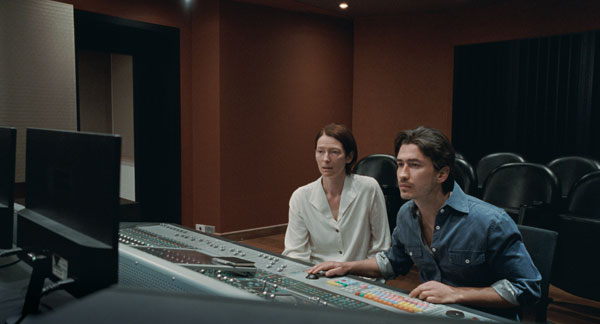
Like his reflective and cryptic Palme d'Or winning “Uncle Boonmee Who Can Recall His Past Lives,” “Memoria” follows its own ostensibly opaque logic, challenging familiar notions of narrative cohesion and keeping us in a near constant state of delighted disorientation. The story is one of restrained obsession, with the marvelous Tilda Swinton as Jessica, a British ex-pat living in Colombia, who meticulously unravels while trying to discover the source (and meaning) of a mysterious sound that keeps repeating inside her head at unexpected moments. The sound, which unsettled me deeply every time it recurred, and which Jessica describes as being “like a big ball of concrete that falls into a metal well,” works beautifully as a metaphor for the generalized omnipresent anxiety we all seem to be living under. Repeatedly, she is kept from sleeping, enjoying a lovely dinner, even sitting quietly and taking in the sights of downtown Bogotá at twilight, by the always abrupt and unexpected thundering blast of noise. Yet Jessica handles her plight with a bemused acceptance — moving quietly and steadily toward the hope of an answer while never giving into despair, her valiance playing like a primer on how to navigate the unthinkable. Even when a creepy doctor refuses her request for Xanax to help her sleep (suggesting instead that a closer relationship with Jesus might do the trick), Jessica smiles politely and doesn’t make a fuss. Instead she attempts to go about her life (she’s an orchid grower concerned with eradicating moisture and mold from her product) while unobtrusively investigating the new phenomenon. And bit by bit she receives clues about what’s happening to her (from a flirty sound engineer, an archeologist, her sister), signs that only come together in the final moments of the film, and even then in the most oblique, non-definitive fashion. Still, her search is pleasurably compelling and includes a marvelous side-trip to a joyous concert of rhythmic jazz where Jessica bops and grooves along with a room full of college kids for three and a half minutes. It’s a tribute to the seemingly organic yet masterfully controlled shape of the director’s vision that he can linger over a single shot so long that it turns time into a dissociative construct, suddenly leaping forward perplexingly, and then stepping nimbly sideways into an alternate version of the world. In lesser hands it would all devolve into nonsense. But Weerasethakul has proven himself to be one of the most singular voices in cinema and nearly incapable of a false move.
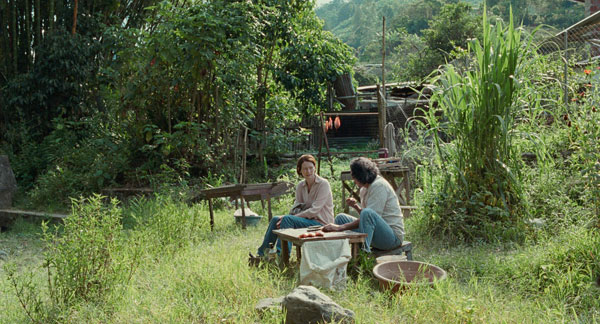
When the film reaches roughly the halfway point, time and memory and reality seem to short circuit, like the lights that flicker off while Jessica visits a library and (later) a museum. People she remembers as dead turn out to be alive; someone she seemed on the verge of having an affair with may not have existed at all. And like the scene in “Uncle Boonmee” where Tong and Jen go out for a meal and yet see themselves staying behind to watch TV, the world of Weerasethakul can splinter into concurrently existing fragments, like an expertly curated version of the multiverse. In the film’s more meditative second half, Jessica travels to the countryside and on the edge of a lush forest, meets a man named Hernan (the dreamy and dreamlike Elkin Díaz) and, after placing her hand on his arm, starts to share his memories. Here, Jessica finally discovers the source of the mysterious sound and the tears flow, not from frustration, self-pity or even relief, but from the new insights into the human understanding she’s achieved through suffering, perseverance and the touch of another human being. Swinton has always been an actor of immense subtlety and grace, and she is magnificent in the role, bringing her trademark beatific composure to the film. And director Weerasethakul more than matches her enigmatic reticence, fashioning an ominous yet strangely consoling masterpiece, the plot of which barely hints at the astonishing beauty on display. At one point we simply watch Hernan sleep (without breathing) while tiny blades of grass wave gently all around his recumbent form. Though the shot goes on for minutes, we’re never bored — only more and more rapt and immersed in this shimmering new reality. And as the outside world (with all its uncontrollable terrors) begins to recede, something new and transformative seeps in: a soothing tonic of barely spoken hope, a treatise on bravery in the face of uncertainty. What it all means is anyone’s guess. Though the plot points are firmly placed, the surrounding mysteries are open to interpretation. But if somewhat puzzling at first, everything deepens as distance is gained. Sort of like having your nose pressed up against a landscape painting and trying to understand what you’re looking at. Only by stepping back is the full picture revealed. As holy and reverent as a prayer, “Memoria,” with its unique elliptical inquiries into memory and shared experience, is a cinematic triumph. Unexplainable and undeniable. It is the surest bet so far this year for a movie lover ready for a vision quest into unease, redemption and bliss. LINK TO SHOWTIMES AND LOCATIONS ON THE "MEMORIA" ROAD SHOW, CLICK HERE
|
|