|
|
JUSTIN TANNER REVIEWS
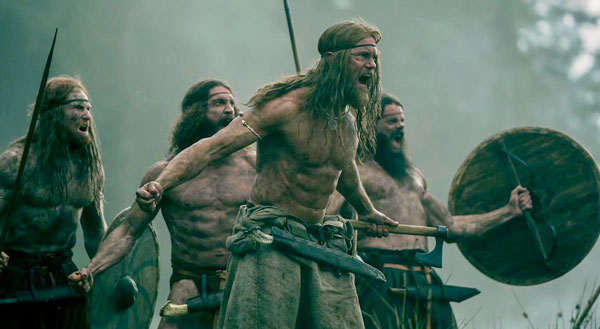
A nearly flawless mixture of arthouse weirdness and studio-prescribed action, “The Northman” manages to do what almost no other two-hour plus film has done in the past year: justify its length. Even at 140 minutes, nothing in director Robert Eggers’ Viking revenge flick feels padded: the second act is just as dynamic as the first and third, and the narrative pulse beats with an inevitability that takes us from the snowcapped opening to the volcanic closing with barely a misstep.
Eggers’ first two films, “The Witch” and “The Lighthouse”, though compelling and strange, are told with a laxity of forward momentum, enjoyable more as artifacts than entertainments. “The Lighthouse” in particular seems to revel in its longueurs, with individual scenes that gleam provocatively in the moment but which don’t seem to fall (as they should), like dominoes with a sense of fixed certainty. In “The Northman,” however, Eggers reels in his more baroque indulgences without losing a bit of originality or creative bite, moving seamlessly from dynamic mayhem to magical realism to sunlit romance, without ever loosening his grip on the story’s underlying veracity. Through a remarkable use of long takes, the tightly choreographed violence employs its kinetic impact to hurl us ever forward. Like watching a blood soaked ballet from the front row, it all unfolds before us in real time without the use of quick cuts to artificially accelerate the action. And Jarin Blaschke’s crisp cinematography (encompassing grey/black frozen vistas, lush viridescent mountainscapes, ochre pig wallows and the sun-dappled teal of a violent sea), brings a seemingly endless banquet of sensual delights, climaxing with a nude man-on-man sword fight illumined from below by scarlet rivers of lava. Much has been made of Eggers’ tireless quest for authenticity, and boy, does it show: The sets, props, weapons and costumes, the terse poetic language of the screenplay, and the damply frigid locations all provide a backdrop of undeniable legitimacy. And the cast, led by a quietly seething Alexander Skarsgård, is exceptional. Whether he’s wearing a wolf pelt and howling at the moon or hacking bodies into kindling while cloaked only in spattered gore, Skarsgård brings a sweaty, muscular hyper-focus to the role. And though his glance is perhaps downcast more than one would wish, whenever we do catch a glimpse of his eyes, there are oceans of pain and regret on display. As Olga of the Birch Forest (a Slavic sorceress who joins forces with Amleth to enact a long-simmering revenge), Anna Taylor-Joy provides lambent magnetism and cunning; and when the romance heats up between her and Skarsgård, the ache of impending loss. But it is an incandescent Bjork who, in her short moonlit scene, most vividly channels Eggar’s pagan motifs.
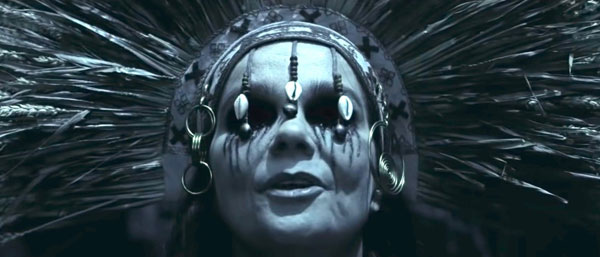
Standing utterly still, with her expressive eyes hidden by dangling seashells, she uses just the wry and delicate play of her face to urge Amleth towards vengeance. It is a dynamite performance. And then there’s Nicole Kidman (as Queen Gudrún), whose bizarre appearance and facial immobility become a distraction each time she appears onscreen. In a period film where every conceivable effort has been made to insure historical accuracy, having her very 21st century plastic surgery front and center is an egregious anachronistic error. In Gudrún’s penultimate scene, a gorgeously written aria that any number of marvelous fifty-something actresses could’ve molded into blistering genius, Kidman can do nothing but wave her arms and shrill up her voice. You can see the emotion bubbling under her frozen features. But it cannot make its way to the surface, and it’s heartbreaking Luckily, the film itself is so assured it easily survives. But be warned: It’s gory. There are scenes of savage cruelty enacted by invaders upon the vanquished. And it’s hard not to draw parallels to some of the unfortunate events taking place on the current world stage. But it’s also a piece of filmmaking mastery with Robert Eggers hitting the sweet spot between art and commerce where both are honored and the audience is the ultimate winner.
|
|