|
|
JUSTIN TANNER REVIEWS THE MENU
Movie trailers are like bait and switch schemes, often having little to do with the finished products. And as an avid filmgoer, I’ve had the dubious pleasure of suffering through multiple viewings of more than a few of these bombastic little promos. Some, like “Don’t Worry Darling’s” mysterious preview, are intriguing at first, only growing tiresome on the third watch. While others, like Spielberg’s “The Fablemans” with its mawkish soundtrack, laughably on-the-nose Hallmark card dialog and the sight of Michelle Williams and Judd Hirsch tearing off great slabs of ham with their teeth, start out cringe-y and soon become as welcome as a root canal. Some trailers are so off the mark, it’s easy to get misled. “Triangle of Sadness” for instance, with its sitcom ‘gotcha’ cuts and overamped Vivaldi score, looked like a hard pass. Only after being coaxed into attending by a friend did I realize Ruben Ostlend’s Palme D’Or winning film was in fact an outright masterpiece and easily the best film of the year. Conversely: Mark (”Succession”) Mylod’s (not quite) black comedy horror film “The Menu” — which boasted a thoroughly beguiling preview with fun hints of a “Most Dangerous Game” plot involving the take down of smug one-percenters — when finally viewed, left me unsatisfied and hungry. The movie, which starts out great and finishes gloriously, has a wobbly, inconsistent mid section which lacks the sufficient imagination to justify its length, and a series of tonal shifts that don’t quite land, leaving portions of the movie feeling opaque and threadbare.
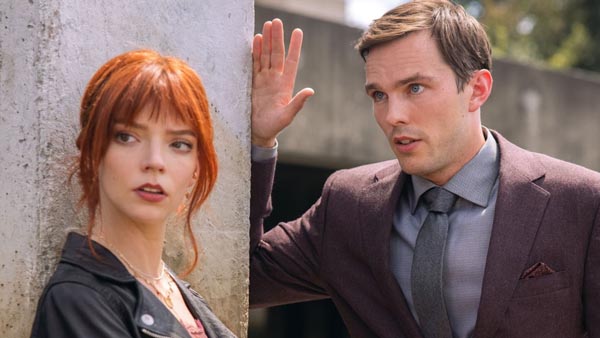
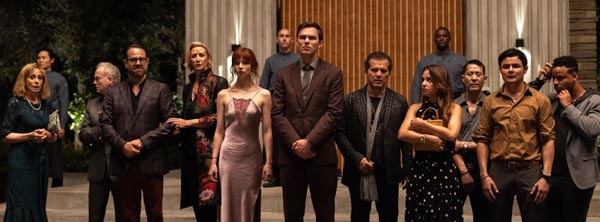
Then, of course, there’s the less-than-fresh culinary jokes about “mouth feel” and molecular gastronomy that any casual viewer of “Top Chef”, “Hell’s Kitchen” or “Chopped” will have heard (and groaned at) a dozen times already. What “The Menu” does have going for it is a terrific supporting cast (including Janet McTeer, John Leguizamo, Reed Birney and Judith Light), gorgeous production design and luscious cinematography, all which help keep the film buoyant (for the most part), during its many digestive loungeuers. And if not all the actors do their best work here (no one is asked to step a centimeter out of their comfort zone), it’s still exciting to see so many marvelous personalities gathered in one room together. So, until it goes off the rails (via a side-swiping transition from satirical realism to credulity-straining pseudo-absurdism) “The Menu” is fun and promising. We first meet Tyler (Nicholas Hault, “Catherine the Great”) and Margot (Ana Taylor-Joy, “The Northman”) dockside, while slurping foam-covered oysters and waiting for the boat that will take them to the exclusive restaurant, Hawthorne, housed in a cement bunker on a private Island, where dinner costs $1250.00 per person.
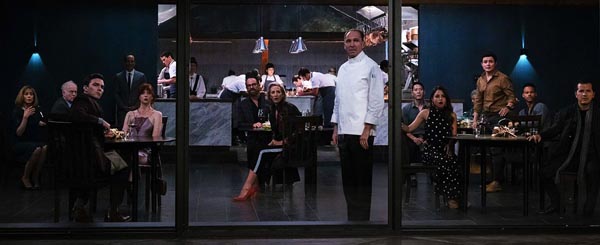
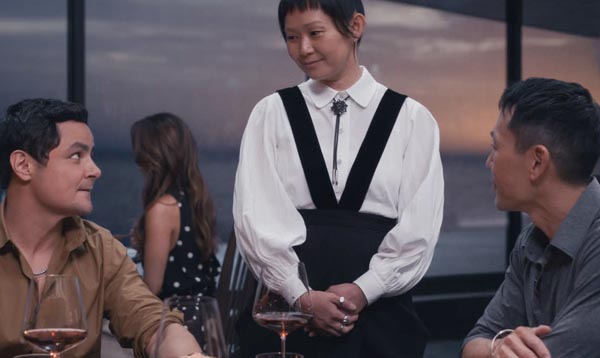
After they and ten other guests are given a tour of the compound by maitre d’ Elsa (Hong Chau, absolutely nailing the tonal balance between obsequiousness and hostility, and giving by far the best performance in the film) everyone is seated in the dining room and a large brutalist metallic wall swings shut with the finality and clang of a prison cell door. From here the movie attempts (only somewhat successfully) to juggle an obvious, but still amusing, satire of haute cuisine elitism with the impending dread of a horror film, as the diners s l o w l y come to realize something sinister is going on in the kitchen. And though obviously great care has been taken with the meticulous details of food prep and presentation, all that work can’t help a script that clearly needs (at the very least) a polish, if not a thorough rewrite of its entire second act. Because the biggest problem with “The Menu” is the menu itself.
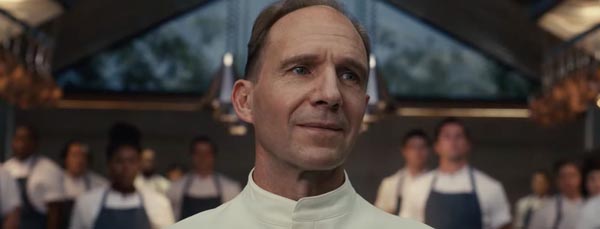
Since each course of the prix fixe meal is presented — along with screen titles and a flourish of activity, not to mention an ear-shattering clap from the chef as a call for silence from the chattering crowd — as a chapter heading or scene break, we are led to expect this meal will itself tell a story. And yet it doesn’t. There is revenge in the air, but the whys and wherefores remain irritatingly vague. There’s no driving force behind the machinations of the plot so the movie never catches fire until “literally” at the end. Most of this is due to a dreary one note performance by Ralph Fiennes as celebrity chef Julian Slowik. Instead of a deliciously cruel villain who takes great pleasure in seeing his overly complicated (and, frankly, under justified) revenge plot enacted in front of his eyes, Fiennes just looks sad. In Vincent Price’s marvelous 1973 black comedy horror film, “Theater of Blood”, Price plays Edward Lionheart, a hammy Shakespearian actor who enacts murderous revenge on the critics who panned his work and denied him an acting award he coveted. The killings are all baroque reenactments of death scenes in various Shakespeare plays and they are staged for maximum Grand Guignol horror.
One particularly brutal death has Robert Morley as flamboyant gourmand Meredith Merridew being force-fed his two beloved toy poodles that have been baked into a pie (in a scene lifted from “Titus Andronicus”). The scene expertly straddles comedy and revulsion, due to Price’s obvious pleasure at seeing his enemy vanquished. And the inventiveness of Anthony Greville-Bell’s screenplay coupled with the tongue-in-cheek (yet fully energized) direction by Douglas Hickox fulfills every expectation set up in the movie’s premise. “The Menu”, however — with its imprecise targeting of people who never seem deserving of what befalls them; its aimless series of unrelated ‘courses’ that lack imagination and momentum; and (most bewilderingly) the seeming lack of self-preservation that keeps the victims from doing ANYTHING to save themselves — only comes alive during the last bonkers moments of the film when, finally, a terrific sequence lands on the screen that’s so fun and outlandish I laughed out loud. But it’s too little too late and “The Menu”, starting out so full of promise and possibility, ends up as...not exactly bad, just disappointing. Or as The Great British Baking Show’s Paul Hollywood might comment: “it’s under-proved, over-baked and claggy.” IN THEATERS
|
|