|
|
JUSTIN TANNER REVIEWS The 40th ANNIVERSARY of
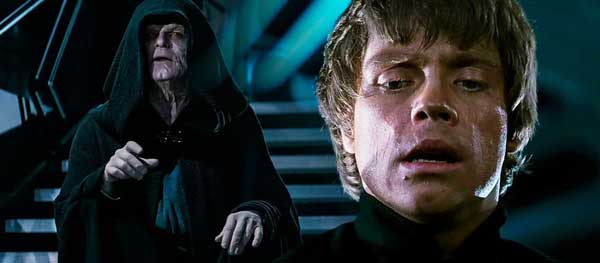
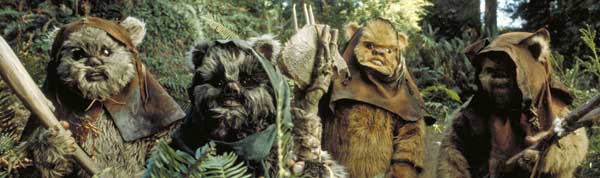
I was in the 7th grade when the first “Star Wars” movie was released and I loved it. Of course thirteen is the perfect age to swallow whole George Lucas’s brand of dorky, unsubtle storytelling. Even with all that blunt instrument dialog and those heartfelt, but gauche, junior college theatre department level performances from its three leads, the movie — enhanced by John Williams’ busily stirring, ersatz Erich Wolfgang Korngold score and John Dykstra’s ILM FX magic — swept me away. Along with most of the country, apparently. Yet, three years later, when “The Empire Strikes Back” came out, I found myself much less enthralled. The imagery and action sequences were still full of energy and thrills — those giant walking machines and all that snow — but this time the dialogue seemed ridiculous and flat. I don’t care what galaxy you come from: nobody talks like that. When “Return of the Jedi” rolled out in 1983, I was no longer a fan but still enough of a sucker for a cliffhanger to want to know how things got wrapped up. Not so well, it turns out. Long before the parade of those nightmarish cuddle bugs, the Ewoks, lumbered onscreen, it was clear this was not a movie for grown-ups. The bad jokes, the ridiculous “Fraggle Rock” creature designs, the endless jabber about “the dark side,” needlessly repeated every ten minutes in case little Timmy was crunching his popcorn too loudly and missed it. By the time the second Death Star got blowed up real good and the teddy bears had their celebratory picnic while belting out John Williams’ gasp-inducing nonsense song “Yub-Nub” — still one of the most cringy moments in film history — I was damp with flop sweat. I remember sneaking out of the cinema before the credits even started rolling, afraid to meet anyone’s eye. But I’m a sucker for punishment, so when the trilogy was rereleased in the late ‘90s — with new exciting footage and anachronistic special effects! — I made a valiant attempt to revisit Lucas world. Only to find that the THX sound system at the classic Vista Theatre in East Hollywood was pitched so high that after the first aggressive blast of Williams’ fanfare, I bolted from my seat in a panic of eardrum melting sonic distress, demanded my money back and never went to a movie theater again without earplugs in my pocket. So it was with queasy trepidation I approached this “who actually gives a crap?” forty year anniversary of “Return of the Jedi.” Could I handle all that cheese? Those bouncy bears? That leering emperor with his bad teeth and Baby Jane makeup? A coked-out Carrie Fisher in her barely-there bikini? Harrison Ford phoning it in? Mark Hamill working way too hard? Could I ever!
As I write this review, the WGA is on strike and The Hollywood Reporter just put out the headline “As Writers Strike, AI Could Covertly Cross the Picket Line.” That’s a scary thought, but from all appearances, AI has been working their little ‘intelligent algorithms’ and ‘iterative processing’ magic for decades. And not to diminish the dread-inducing inevitability of this outcome — or disparage the great Lawrence Kasdan, whose name is on “Return of the Jedi’s” front page as co-writer — but are we sure AI didn’t actually have a hand in this very film? Here are a few examples from the script, culled from Dan Vebber’s “50 REASONS WHY ‘RETURN OF THE JEDI’ SUCKS” published by Film Threat twenty years ago:
It’s hard not to feel hyperbolic when talking about the appalling horrendousness of “Return of the Jedi.” It is, after all, a much beloved film and most critics were enthusiastic with their praise back in ‘83:
And with audiences it was also a huge hit, earning nearly a half billion internationally. That’s in 1983 dollars! Yet the movie is — and ever was and shall ever be — bad. Not just “oh, this doesn’t quite work” bad, or “that might’ve been better” bad, but “thirty car pile up on the interstate” bad. A badness that starts with the very first moment — the hilariously insipid screen crawl which Film Threat’s Dan Vebber described as reading like “a blurb from TV guide” — to the ‘bears with torches’ dance sequence that closes the film. And while someone is to be commended for nixing the tsunamic idiocy of composer Williams’ “Yub Nub” Ewok song, did it really need to be replaced by a New Age World Music anthem for bamboo flute and the Anita Kerr singers? And what’s with all this new footage showing the populations of various planets dancing in the streets? The 1997 CGI images don’t come close to matching the 1983 analog bear jamboree. You can’t give us rough-hewn muppets in the same scene as smooth two-dimensional characters made with imaging software. The incongruity is so obvious it’s frankly insulting. But I’m getting ahead of myself. For the uninitiated — you lucky few! — “Return of the Jedi” tells the overblown and ridiculous story of Luke — a former naive farm boy, now a full blown Jedi Knight (don’t ask) — which basically means he’s gone from wide eyed and endearing to dead eyed and irritating, all in the brief space between sequels — and how he rescues his pal Han Solo from Jabba the Hut and then meets his destiny by facing Darth Vader and resisting the dark side of the force. Meanwhile, two robots, whose names are so irritating I won’t write them down, plod through the margins of the story supplying the kiddies with endless lame attempts at humor. Anthony Daniels, who plays the tall gold Oscar-looking robot, wears out his welcome before the end of his first line; his interactions with the shorter trash can-looking robot — whose beeps and fart noises scream hilarity — are never funny, and they never stop. Add the now-neutered Han Solo to the mix — played with all the charisma of a lamprey by Harrison Ford — and you’ve got more groan-inducing non-yuks than open mic night at the old folks home.
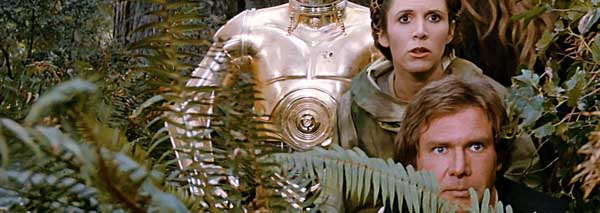
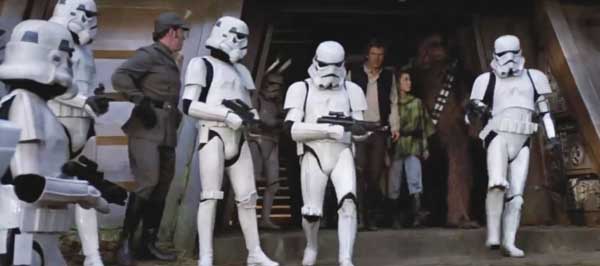
Carrie Fisher shows up as the formerly gritty rebel leader, Princess Leia, but she too has been defanged. No longer the tough no-nonsense commander, she’s now a blank faced Modigliani with dilated pupils, inexplicably mooning over the monosyllabic man-child Han Solo has become. Their supercharged romance dialogue climaxes with Han asking “Who are you?” To which Leia replies “Someone who loves you!” And it’s performed with all the passion of two eleven-year olds on a jungle gym. There’s a story development having to do with unsuspected family ties that should pack an emotional wallop, but, like every other important plot point in the film, it’s egregiously mishandled by the maladroit, fumbling direction of Richard Marquand (”Jagged Edge”). But the editing is the real culprit here. Sean Barton, Marcia Lucas and Duwayne Dunham have cut this thing together with no sense of urgency for the first forty minutes and then, perhaps trying to make up for lost time, ratcheted up the rest of the film into an almost incoherent back and forth duel between competing storylines. It’s like trying to watch TV with a caffeinated six-year-old manning the remote. Meanwhile, Alan Hume’s cinematography keeps everything brown, murky and under lit, John Williams score never stops yelling at us, and the background actors — of which there are hundreds — don’t seem to understand they’re making a movie, or perhaps they were directed to appear constantly bored, confused or both. I had an especially fun time watching the very un-army-like storm troopers slouch and fidget about, not one of them seemingly capable of standing up straight. No wonder they got their asses kicked by a bunch of doll-eyed teddy bears. I did laugh once. When one of the annoying little Ewoks was killed by a stray blaster, his annoying little Ewok friend made an unhappy sound while the music soared. I wasn’t proud of my reaction, but by that point in the film I was so worn down by the repetitive nonsense on display, I certainly wasn’t in my right mind. I could go on — I have pages of this stuff — but there’s only so much piling on one can do before one starts to feel like a storm trooper shooting an Ewok.
Instead I’ll let Pauline Kael take us out with some very prescient writing from her New Yorker review from forty years ago:
Yep. IN THEATERS
|
|