by Gordy Grundy, Editor-in-Chief
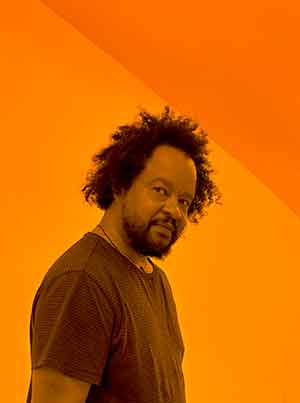 Las Vegas-based artist Brent Holmes is always full of surprises. He was showing me something on his phone, scrolling and scrolling to find it, until I yelled, "Wait. Wait. What's that?" I had seen something that caught my mighty eye. Las Vegas-based artist Brent Holmes is always full of surprises. He was showing me something on his phone, scrolling and scrolling to find it, until I yelled, "Wait. Wait. What's that?" I had seen something that caught my mighty eye.
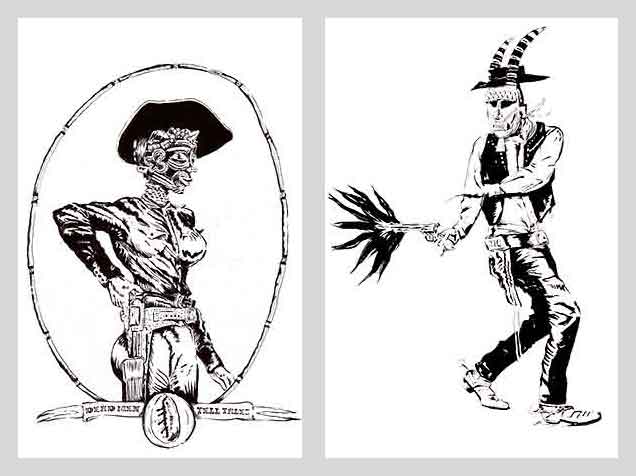
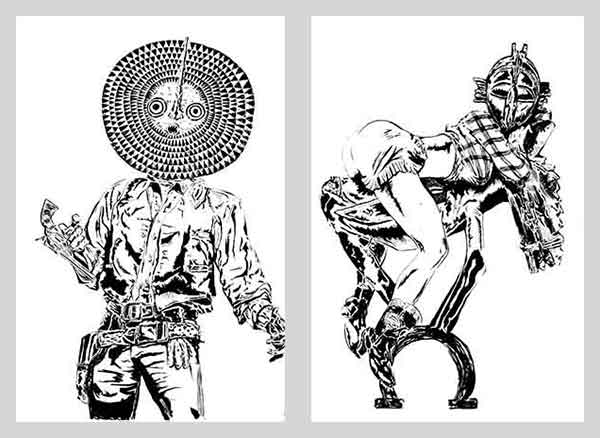
"That's a drawing," he said, "Big at 5 feet by 3 feet." Ink on white paper. Creatively rendered. Careful lines and messy washes. A western cowboy, dirty and dusty, wearing an African mask, was caught leaping in mid-action. I thought of a fast-moving basketball player, street art's The Shadowman, and a twisting man by Robert Longo from his "Men in the Cities" series. My eye kept retreating to the whole image, while zipping-in on the curiosity-making African influences.
I liked the work a lot, and I was about to like it a lot more when Brent added, "It's Afrowestern."
Jumpin' Jehoshaphat. It was. I actually whispered out loud, "Oh My God." Clearly, nothing could be as cool. Afrowesternism.
I'm hep to the established Afrofuturism. I've seen some outstanding and compelling works, yet the science fiction aspect has been a disconnect for me personally. Afrowesternism? I'm in the saddle. I am predisposed. Why hadn't I heard of this before? This is incredible.
Art Report Today: I'm an arts news editor. I thought I knew everything. Why haven't I heard of Afrowesternism?
Brent Holmes: As cultural representation, you've seen Afrowesternism. You’ve seen it in film and music and art, but it's just never been clearly defined.
Little Nas X debuted as Afrowestern. The Knowles sisters are certainly Afrowesternist amongst other things. Afrowesternism occurs any time someone of African descent interprets, adopts, or controls Western iconography.
ART: Are there more of you?
BH: Individuals, yes, many! Some are more dedicated than others, certainly just like Afrofuturism.
Afrowesternism shows up in individual pieces and longer, larger, more dedicated bodies of work. Jordan Peele. His film "Nope" is Afrowestern to the core. Noah Purifoy’s sculpture park in Joshua Tree is to me a sprawling Afrowestern conversation, on the bits and pieces of black identity, as it assembled organically in the West.
The work of Betye Saar has Afrowestern leanings to say the least. Photographer Ivan McClellan is completely dedicated to documenting Afrowestern life in real time. Multi-disciplinary Wunderkind Nikesha Breeze serves heaping plates of it. And musicians like Dom Flemons have more than a foot in the door.
ART: (By now, the Fear Of Missing Out had my heart racing.) How long have you been thinking like this?
BH: That's hard to pin down. I come from cowboys. I was introduced at a young age. My family, and I would be in Texas with my grandparents and cousins once or twice a year. They are the real deal. Ranching and rodeos.
I suppose it came to the forefront of my work about a decade ago. Around 2016, I started to explore the Afrowestern idea intentionally.
It showed up in spurts years before, in performance and video work. I started to recognize it as a movement later on.
ART: How did it begin? What pulled you in? What influences?
BH: My family, certainly my mother. We had Black cowboys in image and in literature throughout the house when I was young. Spaghetti westerns on the TV, and African tribal art decorating the walls.
Exposure to Western art and then transplanting to Nevada in my early twenties had its effect, that is to say, place. Place was probably the greatest influence. Honestly, my study of land art brought me into the western tradition, and my love of pulp fiction and comic books helped me find my sensibility.
After living in Nevada for over a decade, the cowboy seemed like such a primary talking point in American life, and the hyper-distilled version of that icon created by Las Vegas and the surrounding arid western states began to crystallize as images.
ART: I'm so staggered. I think of this as art, but it's also fashion, music, storytelling, cuisine. (Laughing) It's the kind of campfire I want to sit around.
BH: Absolutely, it's an obfuscated narrative, but the prevalence of Black people in the Western era pervades our culture. It's Nikes with spurs on. Sly Stones’ 'Spaced Cowboy.' It's a reclamation of an identity that belongs to Black Americans that we are foundational to.
ART: As we crawl toward a post-racial society, I believe there was a time, long ago in the wild West, when skin color was a very unimportant aspect to survival and daily existence.
BH: The reality of Western expansion is that it was far more ethically diverse than it has been portrayed. The West was brown. Most of what we would call cowboys back then (1860-1900) were of African or Latino descent. The modern iconography, like all things American, is a propagandistic tool utilized to reinforce cultural values to align with white supremacy.
ART: Yeah. Leaping over the ugly stuff, what would an Afrowestern rodeo look like?
BH: There are many Black rodeos around the country. My family has a Father's Day rodeo at the Old William Johnson Arena that is primarily black. The William Picket invitational is another great touring event that highlights black ropers and riders.
It looks like a rodeo, just more melanated. The music is Sam Cooke, Outkast, or James Brown. If you've never seen a cowboy rope a calf to 'Atomic Dog,' the George Clinton song, you've missed a seminal sensory experience. That's all I will say.
ART: What was your Western history like?
BH: I'm a Californian by birth, an east coaster by upbringing, a Texan by blood, and a Las Vegan at heart. I've been bicoastal all of my life. I migrated west with my family, after a long stint on the eastern seaboard, living in New Jersey, New York, and Massachusetts for periods of time. Los Angeles was the place of my developmental years, and the Houston area is the place I deeply associate with home.
The transition to Las Vegas some twenty years ago is what has shaped my perception of the West. The basin and range and Mojave deserts are landscapes I've grown to love and associate with a barren kind of paradise.
Transplanting out into these supple mountain ranges and endless expanses became a big part of me, beyond my creativity.
ART: You mentioned Cliven Bundy. Who was he, and what did he mean to you?
BH: He's a tricky character. Classic American radical individualist. Famed for anti-government stand-offs. In the midst of all that, for whatever reason, Cliven decided to express some opinions about “the American Negro” that became controversial.
As a Nevadan and a Texan with a ranching family that pays taxes on land, I found his thoughts on the circumstances of my people worthy of comment in a video work I made in 2014 called "Yellow Rose of Texas." It was probably my first foray into direct Afrowestern ideation.
ART: Afrofuturism felt a bit gloomy and oppressive, like most Sci-Fi. I feel a great optimism when I think of Afrowesternism. As a notion, it is welcoming. Hopeful. You want to kick up your feet and dance. Take the horse out for a ride.
BH: When we look to the past and reinterpret, it gives more complex, honest, and transparent representations. it opens up more abundant futures, and enriches our sense of identity.
I'm exploring my place in the African diaspora and the roles we all are allowed to play in this culture. The cowboy and the West in general are one of our nations foundational myths, as with all mythology, any alteration or examination gives us insight into our collective perception.
For most of us, the West retains a deep sense of home. It's comfort food for our cultural imagination. For Black people without my upbringing, association with such a core cultural identifier has been more tenuous. But Western culture is intrinsically black. We have been here through all of it, and our presence is a major aspect of the style we associate with the West.
ART: Well said. Is there an element of activism in Afrowesternism? It's funny, but to me, it's not making a statement. It just is. The Afrowestern feels like a lifestyle or an attitude.
BH: I think anything that creates liberatory depictions of historically oppressed peoples and contextualizes them in new and exciting ways is, on some level, activism. But yes, Afrowesternism is a style. It's a movement.
It's been around as long as the American notion of the West, with great historical figures like Nat Love defining the attitude. It shows up all over in fashion, music, and film. It's a cultural exchange.
You can see African style passing into Western ideas and Africans dressing like cowboys. The interesting aspect in all of this is that during slavery, stolen Africans with cattle herding experience developed many of the American standard ranching practices.
ART: I'm looking at some of these images for your show. Tell me, what am I looking at?
BH: These are more sculptural in material and form. I'm using salvaged and treated wood and going for more of a roadside signage feel. They are full color acrylic and oil. The paintings have a bit more depth and form to them. I’ve also incorporated text. I'm working loosely off of Gene Autry’s 'Cowboy Code.' It's a hyper-patriotic ethics guide for kids in the 1950s.
The new work is a little more poppy, and a lot more sloppy when it comes to the brush work in these images. I'm hoping it captures the kind of novice-made images you see on long historical roads like Route 66, aka the Old Spanish Trail.
ART: Are you musical? A musician? What does Afrowestern music sound like?
BH: My ancestry is in music. Dad is a crooner. His mother was an opera singer, and his father sang Jazz. But it never rubbed off on me. I make soundtracks for video works, and I have some musicality, but I would never call myself a musician.
Afrowestern music is Beyoncé, and Charlie Pride. Shaboozey is Afrowestern AF. But it shows up in other places like the Fugees, Tyler The Creator, and Young Thug have their fair share of Afrowestern tracks. Shoot, Reggae is Afrowestern. Jimmy Cliff's "The Harder They Come." Bob Marley's "Buffalo Soldiers."
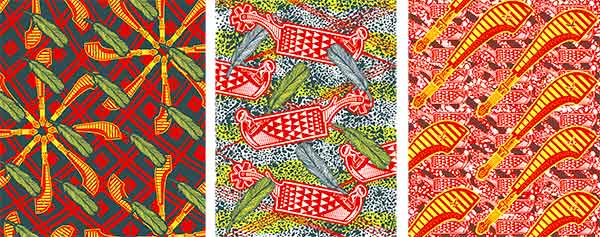
ART: (His phone was open on the table. A flash of color caught my eye.) What's that?
BH: Fabric designs.
ART: Really. What for?
Brent Holmes just smiled and shrugged like a little kid who accidentally spilled a sworn secret. He's up to something.
ART: I'm always thinking of lunch. What would Afrowestern cuisine taste like?
BH: Well, BBQ is certainly both black and western, I'd start there.
Black cuisine is the definitive food of the United States, from trail cooking traditions like hoe cakes, chili, and the entire culinary culture of the American South.
A lot of these ideas around food will be explored in an upcoming exhibition, in a collaboration with Chef Natalie Young, at her downtown Las Vegas restaurant Echo Taste and Sound. Chef Natalie will be exploring the flavors of black cuisine, which will be complemented by Afrowestern music, and the works that I am producing for a new series.
ART: Yah. Ya gotta plug your show. What does the future hold?
BH: That exhibition at Echo Taste and Sound will be sometime in September. I'm working with Nicole Holt, who is such an incredible gallerist, curator, and overall cultural actor in Vegas.
And my friend Erik Beehn at Test Site Projects, who runs a world-class print shop in Las Vegas, will be helping me with some prints. Chef Natalie will be cooking, and we'll have a super-curated soundtrack.
ART: An evening of Afrowesternism. How cool is that?
To many like me, Afrowesternism is a revelation. The notion is one of the greatest things I have ever blindly tripped over. The imagination it inspires rides at a fast giddy up. It is a country I would like to visit, for the landscapes, the music, customs and cuisine. Fashion? Country is going to get some soul and bold colors. A Saturday night hoedown might open at 9 and never, ever close.
------------------------------------------
Artist and writer GORDY GRUNDY is the Editor-in-Chief of Art Report Today
Portrait of Brent Holmes by Maria Cavazos

Back to Main Page
|
|