





Filmmakers, Screenwriters, Performance, Reviews, Film Reviews, Streaming

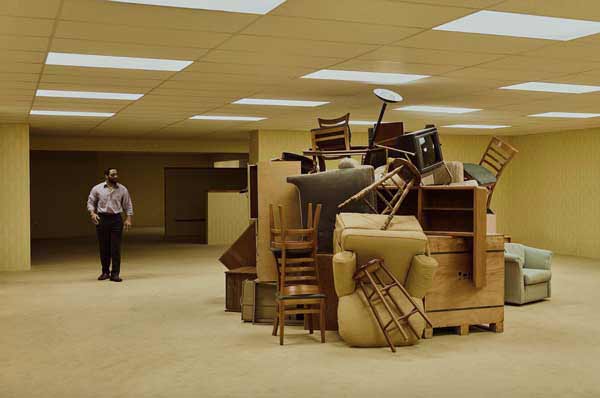
Photo Courtesy of A24
BACKROOMS
by Justin Tanner
One of the creepiest scenes in Kane Parsons' feature debut "Backrooms" occurs before we even enter the disturbing liminal nightmare of the title. Early in the film, Clark (Chiwetel Ejiofor), the owner of a failing furniture store, is forced to sleep at work after being kicked out by his wife. In the middle of the night he wakes up in the cavernous warehouse, surrounded by display furniture, a lone table lamp casting a small pool of light into the darkness. Beyond it, the walls seem impossibly distant. The ceiling might as well extend into infinity. It's an unsettling image, slightly reminiscent of Wendy preparing breakfast in the Overlook Hotel's enormous industrial kitchen in "The Shining." Nothing frightening is happening. And yet the familiar has somehow become alien.
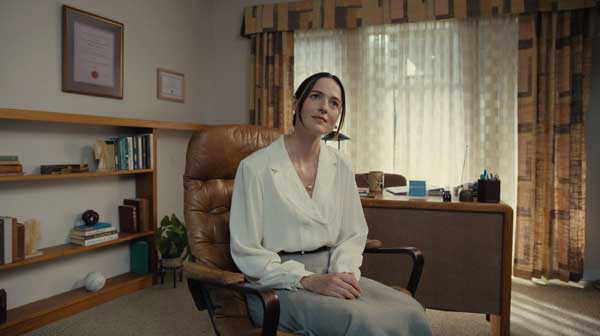
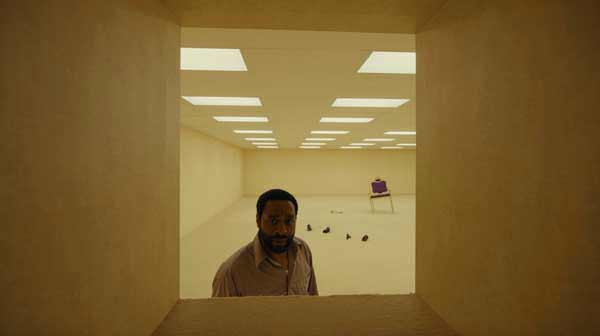
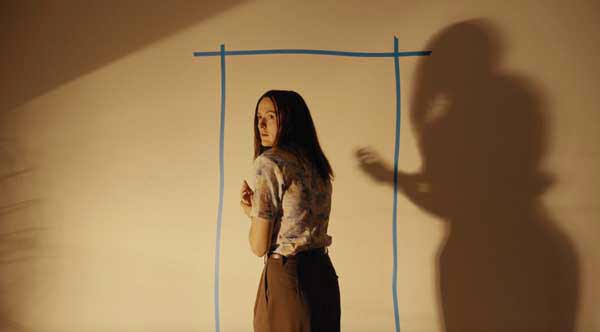
Ejiofor is all steel and regret as a man whose business and marriage are simultaneously collapsing. Even his therapist (a beautifully remote Renate Reinsve) struggles to reach him. Clark has stopped trying to make sense of the world. Every day he sits in a warehouse without customers; every night he sleeps alone in a giant room. Untethered from his marriage, his livelihood, and increasingly from himself, he drifts through life like a ghost haunting his own existence. Then one night, while investigating strange electrical disturbances, Clark discovers a pencil-thin line of light running floor to ceiling in a basement wall. There is no seam, no doorway, no visible opening. Yet when he reaches out, his hand passes straight through. A moment later, he steps inside. Welcome to the Backrooms: an endless maze of hallways, ramps, crawlspaces, and dead ends illuminated by buzzing fluorescent lights and littered with mismatched furniture, moldering clothing, and perhaps something unspeakable lurking just out of sight. Like empty cinemas, abandoned parking garages, or a mall at three in the morning, the Backrooms are a deeply liminal space, the sort of place that seems ordinary until its emptiness begins to feel uncanny. Most of us have experienced something similar. As a child, I remember waking in the middle of the night on a cross-country train trip and wandering through a series of empty railcars. At some point I realized I wasn't entirely sure how far I'd walked or whether I'd recognize my compartment when I found it again. For a brief moment I became convinced the train might continue forever and that my room had somehow disappeared. Yet nothing seemed amiss. Which somehow made it worse. With "Backrooms," Parsons has taken that half-remembered sensation of wrongness and given it physical form. A 2019 image of an eerily empty yellow office space and a cryptic piece of accompanying text spawned an entire mythology of videos, games, fan fiction, and collaborative world-building projects. But it was Parsons who transformed the concept into something genuinely haunting. Beginning in 2022, under the name Kane Pixels, he released a series of short films that combined faux-documentary camerawork, precise sound design, and startling visual effects to create a nightmare world that felt simultaneously artificial and disturbingly real. As the videos racked up millions of views, it was only a matter of time before Hollywood came calling. When A24 announced a feature adaptation a year later, I wondered whether Parsons could make the leap from internet phenomenon to filmmaker. The answer is yes. Hell yes.
"Backrooms" is a triumph of atmosphere, tension, and nerve. Without relying on a single jump scare, Parsons sustains an almost unbearable sense of dread, creating the sort of slow-burn nightmare horror cinema has been missing for years. Part of what makes the film so unsettling is its refusal to anchor itself too firmly in its 1990 setting. Parsons largely sidesteps the nostalgic clutter of period filmmaking. There are no wink-and-nudge cultural references reassuring us we've arrived in the past. The result is a strange temporal dislocation reminiscent of Charles Laughton's "The Night of the Hunter," where the story seems to exist outside of time altogether. Apart from the absence of cell phones, the only clear signifier of the era is a cheesy television commercial Clark films for his store, dressed as a pirate and speaking in an atrocious accent reminiscent of the local ads that dominated late-night television when I was a kid. Yet even this serves a deeper purpose. Clark's reluctance to commit to the performance underscores his growing withdrawal from life itself. In that regard, the Backrooms become a kind of refuge. The discovery of miles of winding corridors is the first moment in the film where Clark appears fully engaged with the world. He spends days — perhaps weeks; time seems to behave differently there — mapping the maze and bringing his discoveries to Mary. It's a fascinating inversion. The "real" world has become sterile, repetitive, and emotionally dead, while the impossible world beyond the wall offers curiosity, purpose, and wonder. For Clark, the Backrooms are terrifying. They're also the first thing that has made him feel alive in years. Much of the film's uncanny power comes from Danny Vermette's practical production design. Occupying more than 30,000 square feet across four soundstages, the physical Backrooms create a maze so vast and confusing that cast and crew reportedly became lost inside it with alarming regularity. Even more impressive is Parsons' unnervingly disciplined direction. The opening scenes, especially the therapy sessions, are played with a near-Kubrickian severity. Performances are stripped down, dialogue is sparse, and every frame feels airless with repression. The film is claustrophobic long before we reach the Backrooms. As Clark and Mary's emotional wounds come into focus, Parsons hints that the labyrinth itself may be a form of architecture built from pain.
Fans eager to dive into the deeper mythology can find it in Parsons' earlier shorts, but the film itself remains admirably uninterested in explaining everything. Some viewers have taken issue with the film's ambiguous ending and refusal to provide clear answers. I felt exactly the opposite. The Backrooms are frightening precisely because they resist easy understanding. Parsons reveals just enough to suggest a larger reality beyond the edges of the frame, then trusts our imaginations to do the rest. Apparently there are more chapters of the Backrooms in the works, which comes as welcome news. Even at nearly two hours, the film feels less like a conclusion than the opening of a door. By revealing only a fraction of its mythology, Parsons creates the rarest of cinematic pleasures: a genuine hunger to know more. I want to see what's down there in the lowest levels. I want to know what's waiting around the next corner. Most of all, I want to go back. Weeks later, I still can't get the place out of my head. IN THEATERS |
|
An LA-based playwright, JUSTIN TANNER has more than twenty produced plays to his credit, including Voice Lessons, Day Drinkers, Space Therapy, Wife Swappers, and Pot Mom, which received the PEN-West Award for Best Play. He has written for the TV shows Gilmore Girls, My So-Called Life and the short-lived Love Monkey. He wrote, directed and edited 88 episodes of the web series Ave 43, available on YouTube. Tanner is the current Playwright in Residence for the Rogue Machine Theatre in Hollywood, where his most recent play My Son the Playwright, of January of 2026, was met with rave reviews. Travis Michael Holder of the LA Drama Critics Circle wrote, "a phenomenal new achievement by local counter-culture hero Justin Tanner.”
|


To receive a free subscription to our Sunday Lounge! newsletter, Click Here
Have a suggestion? Send an email to the Editor, Click Here