





Filmmakers, Screenwriters, Performance, Reviews, Film Reviews, Streaming

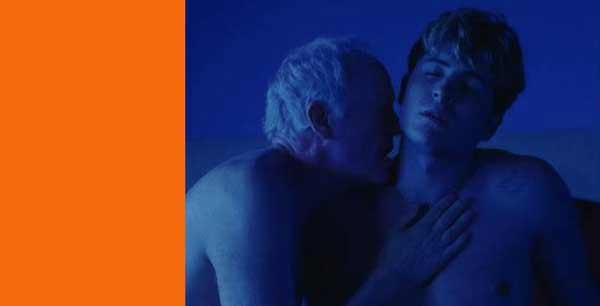
Photo Courtesy of Obscured Releasing
BLUE FILM
by Justin Tanner
It's difficult to dunk on a micro-budget indie film, especially one whose heart appears to be in the right place. It's harder still when that film arrives trailing both a provocative marketing campaign and warnings about how perilous its subject matter is. Add to that reports that it was rejected by both Sundance and SXSW for its scandalous content — and inspired walkouts when it finally premiered at the Edinburgh International Film Festival — and, naturally, I was intrigued. But it was the early reviews that really made my heart pound, describing the film as "genuinely shocking," "ethically discomfiting," "hard to stomach," "very dangerous," "raw," "skin-crawling," "perverse," and, my personal favorite, "leaves you feeling a little bit ill." And so I hunkered down to watch "Blue Film" the other night, popcorn in hand, smelling salts nearby, fully prepared to be scandalized. Instead, I spent much of the evening wondering what all the fuss was about. Whatever inspired all that outrage, it wasn't the subject matter. Then again, perhaps I'm jaded. In any case, spoilers ahead. The verboten topic at the center of "Blue Film" is pedophilia, or more specifically, a discussion about pedophilia between two adult gay men. Yes, one of those men is a convicted child predator and the other his former student. But this is not a "Hard Candy" or "How I Learned to Drive" scenario in which a victim confronts his abuser. In fact, there is no child sexual abuse depicted anywhere in the film. Though the former teacher did corner a twelve-year-old in a school bathroom decades earlier, the boy escaped before any assault took place. The teacher was arrested, served seven years in prison, and subsequently reinvented himself as a devoutly religious celibate. I spell out these details because they're essential to understanding just how restrained the movie actually is. Personally, I found more transgression and moral ambiguity in a single episode of "To Catch a Predator" than in anything "Blue Film" has to say on the subject. Perhaps that's because I'd recently watched David Osit's documentary "Predators," which explores not only child predation but the strange public spectacle surrounding its exposure. Compared to that film's uncomfortable questions about vigilantism and public humiliation, "Blue Film" feels oddly neutered, reducing a deeply complicated subject to little more than two actors performing a series of implausible role-playing scenarios. And the problem is compounded by Tuttle's decision to tell the story through a queer lens. Whether intentionally or not, any film linking homosexuality and child predation enters fraught territory. For decades, anti-gay activists have falsely conflated the two, a smear that continues to circulate today. Material this volatile demands unusual rigor and insight if it hopes to transcend the baggage it inevitably carries. Tuttle's ambition is admirable, but those are precisely the qualities his screenplay lacks. The film is clearly reaching for difficult questions. It simply doesn't understand them well enough to ask them.
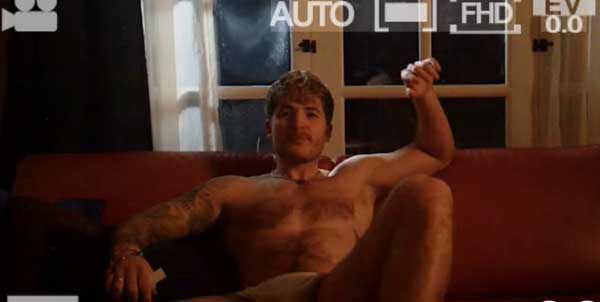
Kieron Moore plays Aaron, a thirty-year-old cam performer whose online persona revolves around playing a rough-trade "straight" hustler, insulting and occasionally roughing up clients looking to indulge their submissive fantasies. We first meet him during a livestream, clad only in white briefs and repeatedly hurling slurs at his audience while flexing for more than five hundred paying viewers. As an introduction, it's surprisingly effective. Moore's confrontational performance suggests we're about to venture somewhere genuinely risky. If the film is willing to begin here, surely darker territory awaits. It doesn't. But the real problem isn't shock value. It's characterization. "Blue Film" hinges on two propositions that the screenplay never adequately explores: that Aaron is a seasoned hustler with a firm grasp of professional boundaries, and that one of his viewers, Hank, a seventy-year-old grocery bagger (Reed Birney), would liquidate his savings and fly across the country for a night whose purpose remains frustratingly vague. From the moment Hank offers Aaron fifty thousand dollars for his services, the film begins piling up decisions that demand explanation. Aaron agrees to meet a stranger in a private residence, accepts only half the money up front, overlooks the fact that Hank refuses to remove a ski mask, and consents to being filmed despite making his living from his image. Then, in the film's most revealing omission, Aaron — whose rough-trade identity is built around his hirsute masculinity — allows Hank to shave him completely with a tiny Bic razor so he can more convincingly resemble the younger object of Hank's desires. It's a startling act of submission and self-erasure. Yet instead of showing the emotional calculus that led to it, the film simply cuts to the middle of the process. Which is frustrating because both actors are more than capable of carrying the weight of their character’s motivations, if only we were allowed access to the workings of their minds. Reed Birney gives a thoughtful, unsettling performance as Hank, carefully modulating between vulnerability and menace. And his scenes with Moore occasionally approach the moral complexity promised by the film's provocative reputation, particularly when Aaron adopts the persona of a twelve-year-old boy during one of Hank's role-playing scenarios. But just as the film threatens to engage with the implications of its own premise, it loses its nerve. Aaron abruptly ends the encounter and the film jumps ahead. Suddenly he's sitting in an empty bathtub while Hank occupies the floor beside him. The emotional temperature has completely changed. Clearly something important has been said. We simply aren't allowed to hear it. And that pattern repeats throughout the film.
Aaron and Hank spend much of the running time talking, yet rarely seem to be having an actual conversation. In trying to make the characters guarded and mysterious, writer-director Tuttle renders them frustratingly opaque. When Aaron asks Hank why he came, for instance, Hank replies, "I want to know you for who you are now." Why? "Because I want to know if I still love you." Birney brings all of his considerable skill to the exchange, but even he can't make the line feel emotionally coherent. There are a few awkwardly staged sex scenes, which may well account for some of the reported walkouts. Both actors are certainly committed, but the scenes never develop the psychological tension necessary to justify their existence. Because neither character appears particularly interested in the encounters — and neither seems to derive much pleasure from them — the intimacy quickly becomes uncomfortable to watch. Not because it's transgressive; because it's confusing. For a film ostensibly concerned with forbidden attraction, "Blue Film" spends surprisingly little time helping us understand what either man actually wants. The result isn't a scandalous film. It's an incomplete one. AVAILABLE TO RENT ON FANDANGO AT HOME |

|
An LA-based playwright, JUSTIN TANNER has more than twenty produced plays to his credit, including Voice Lessons, Day Drinkers, Space Therapy, Wife Swappers, and Pot Mom, which received the PEN-West Award for Best Play. He has written for the TV shows Gilmore Girls, My So-Called Life and the short-lived Love Monkey. He wrote, directed and edited 88 episodes of the web series Ave 43, available on YouTube. Tanner is the current Playwright in Residence for the Rogue Machine Theatre in Hollywood, where his most recent play My Son the Playwright, of January of 2026, was met with rave reviews. Travis Michael Holder of the LA Drama Critics Circle wrote, "a phenomenal new achievement by local counter-culture hero Justin Tanner.”
|


To receive a free subscription to our Sunday Lounge! newsletter, Click Here
Have a suggestion? Send an email to the Editor, Click Here