





Filmmakers, Screenwriters, Performance, Reviews, Film Reviews, Streaming


Photo Courtesy of A24
MARTY SUPREME
by Justin Tanner
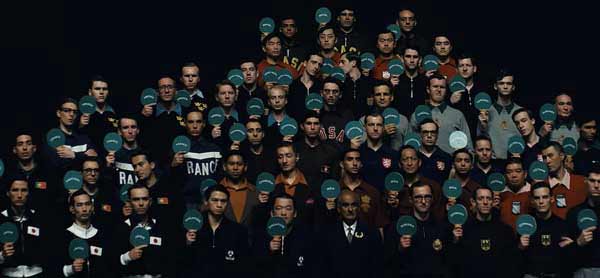
With his latest film — and his first solo outing since 2008 — director/screenwriter Josh Safdie accomplishes something I wouldn’t have thought possible: turning ping-pong, the sort of game I associate with drunk people in basements, into a thrilling spectator sport. Set in the postwar 1950s, “Marty Supreme” follows Marty Mauser, a weaselly hustler who somehow also happens to be one of the greatest table-tennis players on earth — despite exhibiting almost none of the discipline such greatness would seem to require. Away from the table he’s pure chaos. But put a paddle in his hand and he suddenly moves with astonishing precision and grace. Timothée Chalamet brings innate charm and dorky vulnerability to the role, softening our dislike of this self-absorbed know-it-all whose complete lack of empathy alienates nearly everyone he meets. Like other cinematic overachieving jerks — Jordan Belfort, Mark Zuckerberg — Marty remains strangely easy to root for. Watching him steamroll a parade of snotty bureaucrats and brown-nosing flunkies provides an undeniable vicarious thrill, at least initially. Safdie’s love of cinema is equally infectious. Like a less self-conscious Scorsese, he channels his encyclopedic knowledge of film into pure momentum, finding ways to make even the smallest moments feel charged and slightly out of control. He shoots each ping-pong match like a nerve-shredding action sequence, using agile camerawork, razor-tight editing, and actors who move with the speed and desperation of real athletes. The dialogue, co-written with Ronald Bronstein, is just as sharp — natural enough to feel overheard, yet heightened enough to reveal the intelligence shaping it. Special credit is due to casting director Jennifer Venditti, whose unparalleled eye for vividly specific faces and personalities gives “Marty Supreme” much of its scruffy texture and humor. Every actor — professional or nonprofessional — contributes some strange little spark of individuality that keeps the film feeling alive. The movie starts strong with an exhilarating series of ping-pong matches in London, where Marty dominates until he’s defeated by a Japanese rival — a conflict made even more loaded by the still-fresh memory of World War II. The promise of a rematch in Japan gives the film a clear objective: Marty must somehow raise the money to reclaim his honor. But what follows is a long series of arbitrary reversals: Marty gets the money, loses the money, gets it back, loses it again. Eventually the movie traps itself in the same repetitive rhythm as the sport it’s depicting — all return shots, no forward movement. Making matters worse are two unnecessary subplots that hijack the film at its midpoint: One involves director Abel Ferrara as a gangster searching for a lost dog, a thread that seems to exist largely so Safdie can indulge his usual taste for balletic violence. The other concerns Marty’s affair with a fading movie star (Gwyneth Paltrow) as she prepares for her Broadway debut in what feels like a lost William Inge play. And while both detours are amusing in isolation, neither meaningfully alters Marty’s central arc. They merely inflate the running time — and at two and a half hours, you really feel it. Eventually all the hustling, blackmail, fraud, dog-napping, adultery, and assorted acts of sociopathic mayhem begin to wear thin. Even when each small triumph is followed by an equally humiliating setback, Marty never seems capable of learning anything from the experience. That wouldn’t necessarily be a problem — Paul Newman built a career playing charming brutes like Hud, men whose refusal to change eventually becomes tragic. But Safdie wants to have it both ways, presenting Marty as an irredeemable prick, then asking us to embrace a redemption arc without bothering to include the part where Marty actually changes in any perceivable fashion. The film’s ending — a prolonged close-up of Chalamet, tears streaming down his face in a finale oddly reminiscent of “Call Me By Your Name” — reaches for an atonement that it hasn’t earned. And honestly, just because an actor is good at crying doesn’t mean we need to watch him do it uninterrupted for five full minutes. Again. Safdie does hit most of the right notes with the final ping-pong showdown, crafting a pulse-pounding climax worthy of classic sports movies like “Hoosiers” or “Remember the Titans.” The problem is that Marty never really feels like an underdog. No matter how much manufactured adversity Safdie piles on, the outcome still feels predetermined. And the rah-rah wave of American nationalism that overtakes the final match is a bit much to swallow given the current cultural moment.
“Marty Supreme” is like being cornered at Thanksgiving by your favorite uncle after too many cocktails: the stories go on too long, the points repeat themselves, and eventually the performance becomes a little exhausting. But Safdie’s filmmaking is so alive — so jittery, funny, and compulsively cinematic — that even when the movie is spinning its wheels, it remains strangely exhilarating company. STREAMING ON HBO MAX |
|
An LA-based playwright, JUSTIN TANNER has more than twenty produced plays to his credit, including Voice Lessons, Day Drinkers, Space Therapy, Wife Swappers, and Pot Mom, which received the PEN-West Award for Best Play. He has written for the TV shows Gilmore Girls, My So-Called Life and the short-lived Love Monkey. He wrote, directed and edited 88 episodes of the web series Ave 43, available on YouTube. Tanner is the current Playwright in Residence for the Rogue Machine Theatre in Hollywood, where his most recent play My Son the Playwright, of January of 2026, was met with rave reviews. Travis Michael Holder of the LA Drama Critics Circle wrote, "a phenomenal new achievement by local counter-culture hero Justin Tanner.”
|


To receive a free subscription to our Sunday Lounge! newsletter, Click Here
Have a suggestion? Send an email to the Editor, Click Here