





Filmmakers, Screenwriters, Performance, Reviews, Film Reviews, Streaming

All Photos Courtesy of Neon
ALL OF A SUDDEN
by Justin Tanner
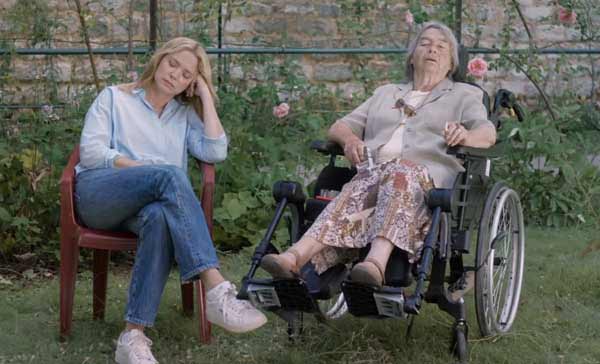
What could be more pretentious than starting a film review by quoting Tennessee Williams? But hear me out. Ryūsuke Hamaguchi has made theater and theatrical performance central to several of his films, including his Oscar-winning “Drive My Car” (2021) and his latest, the deeply humane “All of a Sudden.” Besides, a passage from Williams's 1961 play “The Night of the Iguana” neatly sums up the question at the heart of Hamaguchi's new film: How do we accept mortality without surrendering our dignity? In “Iguana,” a ninety-year-old poet is working on his final poem, drawing inspiration from watching oranges wither on a tree and fall to the ground without complaint. He wonders whether human beings might face death with the same quiet courage, praying that it might find a home not only in nature, but “in the frightened heart of me.” Set in “The Garden of Freedom,” a fictional private eldercare facility outside Paris, “All of a Sudden” drops us into the middle of a training session in which nurses are practicing Humanitude, a real-life caregiving methodology that emphasizes respect and empathy, with an elderly dementia patient. The scene is long enough for us to experience both the exhaustion and fulfillment of the technique. Its benefits are poignantly clear, but so are the physical and emotional demands it places on caregivers, creating a tension that runs throughout the film.
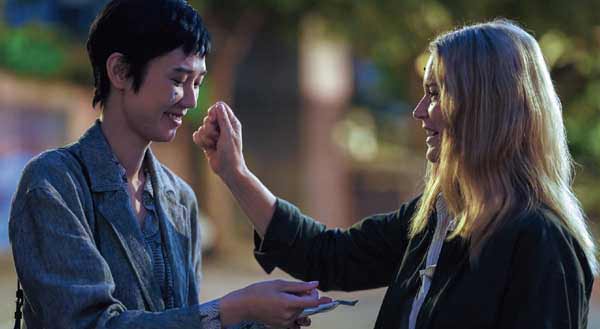
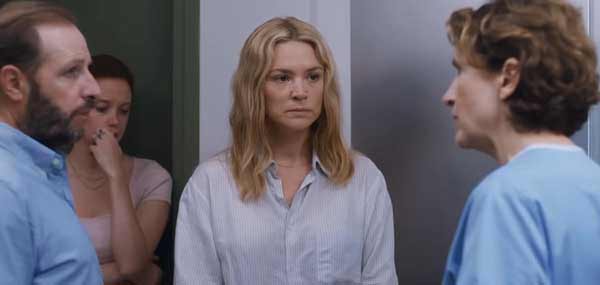
Marie-Lou (Virginie Efira), the facility's seemingly saintlike new director, is a passionate advocate of Humanitude, which, among other things, encourages patient mobility. Her efforts meet resistance from both cost-conscious administrators and veteran nurses, particularly Sophie (a wonderfully grumpy Marie Bunel), who worries that keeping dementia patients on their feet increases the risk of falls. But Sophie raises an even more troubling objection: the facility's funding is partly determined by its patients' level of dependency, meaning that improving their mobility could actually result in reduced financial support. It's the kind of bureaucratic absurdity in which doing the right thing becomes a financial liability. The relentless demands of the job soon take their toll on Marie-Lou, who begins showing signs of burnout. She can barely sleep, and whenever she manages to steal a moment's rest, another crisis demands her attention. One afternoon, riding a bus, she rests her head against the window, seemingly on the verge of tears, when she notices a young man running recklessly alongside the vehicle. Concerned for his safety, she gets off to investigate, setting in motion an unexpected encounter with Mari (Tao Okamoto), a Japanese playwright who has been diagnosed with terminal cancer.
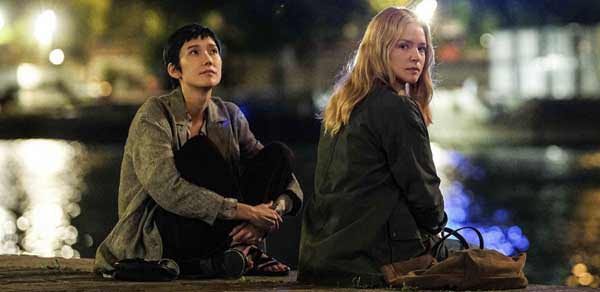
What follows is something like a meet-cute, though the relationship that develops between the two women is less romantic than philosophical. Marie-Lou has devoted herself to helping people navigate the final stages of their lives, while Mari is confronting the imminent end of her own. Their circumstances are different, but their concerns prove remarkably complementary, and the film gradually settles into a series of long, gorgeous conversations between them. I first saw “All of a Sudden” back in September, a day after watching Alejandro G. Iñárritu's “Digger,” and was struck by the similarities between the two films. Both confront the fear of impending death, but in radically different ways. One says, essentially, we're all going to die, and nothing can save us. The other asks: Given that we're all going to die, how should we treat one another while we're here? Both also rely on stage plays to enrich their stories, though neither makes a particularly compelling case for the art form. “Digger's” play, “Fossil Fools,” which occupies roughly eighty-five percent of the film, is an overwritten piece of “I told you so” agitprop, so smugly certain of its own brilliance that merely watching it becomes a chore. The play in “All of a Sudden,” “Up Close, No One Is Normal,” written by Mari, is similarly unsatisfying, though for reasons that are harder to pin down. Falling somewhere between performance art and a poetry reading, it suffers from a curious lack of stagecraft. Apart from a swinging blue globe and an audience supplied with musical instruments to play intermittently, without invitation or apparent provocation, it feels like a college essay, overly earnest and vague at the same time. Yet, the audience, including Marie-Lou, is enraptured. And as in “Digger,” the disconnect between what we're watching and how the characters respond to it is disconcerting. Fortunately, “Up Close, No One Is Normal” occupies only about ten minutes of screen time and is soon forgotten, though a brief reprise near the end reminds us that, while Mari is a marvelous raconteur with plenty on her mind, her playwriting skills leave much to be desired.
That's cattier than I intended to be. “All of a Sudden” is a profoundly moving film, acting on the spirit like a balm against our chaotically troubled times. It has the bravery to embrace, without embarrassment, ideas of connection and forgiveness. Hamaguchi responds to the anxieties of the contemporary world with an almost radical insistence on compassion. He's taken something most filmmakers would consider dramatically unpromising — the daily routines of caring for people with dementia — and discovered within it a profound question about what it means to recognize another person's humanity. There are moments, especially near the end, when the film seems to be answering questions we barely know how to ask about who we are, why we're here, and how we're supposed to navigate an increasingly incomprehensible world. But there's no getting around the fact that this is a three-hour-and-seventeen-minute film with almost no conventional dramatic tension. It doesn't pull us along like a typical narrative. Instead, it invites us to sit, listen, and feel. Perhaps the film's duration is part of its argument: Hamaguchi gives his characters the same time and attention that Marie-Lou insists on giving her patients. The film practices the philosophy of care it advocates. Like a long drive to a place of breathtaking beauty, the destination makes the journey worthwhile. Short bouts of carsickness notwithstanding. Admittedly, so much unwavering nobility can sometimes feel smothering. When Marie-Lou and her coterie of virtuous nurses advocate for uninterrupted kindness, they occasionally resemble the cape-wearing heroes of the Justice League, ready to smite any wayward caregiver who might dare knock on a patient's door fewer than the prescribed seven times before entering. And there's an awful lot of back-patting to wade through. “You're great.” “No, you're great!” When Sophie accuses Marie-Lou of being condescending, we understand her point. There is such a thing as too much benevolence.
But Hamaguchi ultimately wins over my inner cynic through sheer honesty and conviction. He means what he says. He's a true believer in the healing power of art and human connection, and that belief is positively contagious. In Mari's play, the central character is Franco Basaglia, the Italian psychiatrist whose efforts to reform psychiatric institutions in the 1970s helped bring an end to many of their dehumanizing practices. At one point, he asks the audience, “Are healthy people truly alive?” I take this to mean that without confronting the frailty of our own bodies, can we fully understand what it means to want to live? It's a question I'm still turning over in my mind, and one that alone earns “All of a Sudden” my admiration. It's rare to leave a film with a new understanding of what communication between people can mean. Hamaguchi's film may sometimes feel like being in a classroom, but if empathy is what he's teaching, I got the lesson. IN THEATERS |

|
An LA-based playwright, JUSTIN TANNER has more than twenty produced plays to his credit, including Voice Lessons, Day Drinkers, Space Therapy, Wife Swappers, and Pot Mom, which received the PEN-West Award for Best Play. He has written for the TV shows Gilmore Girls, My So-Called Life and the short-lived Love Monkey. He wrote, directed and edited 88 episodes of the web series Ave 43, available on YouTube. Tanner is the current Playwright in Residence for the Rogue Machine Theatre in Hollywood, where his most recent play My Son the Playwright, of January of 2026, was met with rave reviews. Travis Michael Holder of the LA Drama Critics Circle wrote, "a phenomenal new achievement by local counter-culture hero Justin Tanner.”
|


To receive a free subscription to our Sunday Lounge! newsletter, Click Here
Have a suggestion? Send an email to the Editor, Click Here