





Filmmakers, Screenwriters, Performance, Reviews, Film Reviews, Streaming

All Photos Courtesy of Warner Brothers Pictures
ARUM
by Justin Tanner
Michael Haneke’s 2009 film, “The White Ribbon,” is about the seeds of fascism and the circumstances under which they germinate, seen through the eyes of children in a North Germany village just before World War I. The film is a mystery without a solution, as a series of brutal acts and small-scale terrorism plague a rural village, much of it directed toward those perceived as outsiders. What makes the film so chilling is Haneke’s suggestion — nothing is ever spelled out — that the escalating barbarity begins with the ordinary cruelties practiced by the adults. Their children watch and absorb everything, until abuse begins to replicate itself: innocence gives way to indifference, then bullying, aggression and finally violence. The implication is that these children will come of age in the Germany that embraces Nazism. Fascism, Haneke suggests, doesn’t spring fully formed from a single source. It comes from our homes and communities, nurtured by cruelty, suspicion and the need for someone to blame.
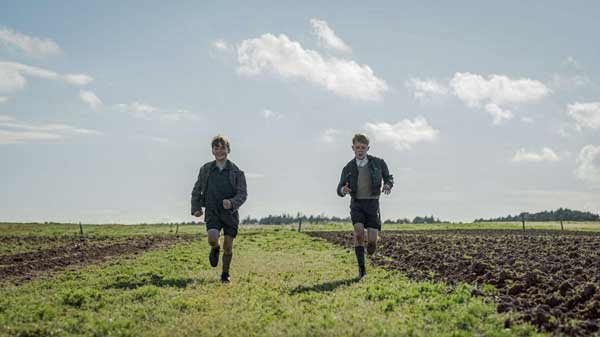
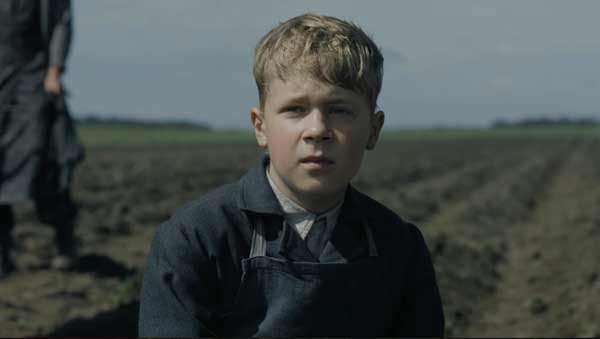
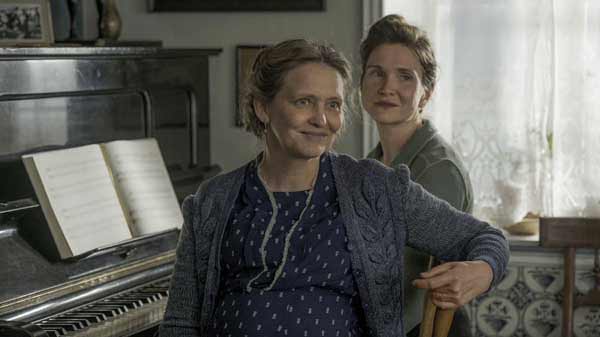
“Amrum” begins roughly three decades later, at the other end of that historical trajectory. The seeds Haneke watched being planted have long since flowered, and now a different generation of German children must watch the world built from them collapse. The story, based on German filmmaker and actor Hark Bohm’s autobiographical novel of the same name, draws on his childhood memories of the final weeks of World War II. At its center is ten-year-old Nanning, a member of the Deutsches Jungvolk, the branch of the Hitler Youth for boys under fifteen. After being bombed out of Hamburg, he has relocated with his family to their ancestral home on Amrum, a remote island in the North Sea. There he lives with his two brothers, his staunchly Nazi mother and an aunt who is a Mitläufer — literally a “fellow traveler,” someone who went along with the regime without necessarily sharing its ideology. Nanning still wears his German Youth uniform of tan shirt, black shorts and black neckerchief, but his natural curiosity keeps him searching beyond what he’s been taught for answers to questions he can barely formulate. In one scene, Nanning and his best friend, Hermann (Kian Köppke), are discussing “Moby Dick,” with Hermann suggesting that Ahab is like Hitler and the Pequod is Germany. “Then who is Moby Dick?” Nanning asks. The boys run through the possibilities — the Americans, the Russians, Churchill — before finally landing on, “Maybe Moby Dick is supposed to be God.” It’s a remarkably mature conversation for two ten-year-old boys, yet the world of the film is so grounded, and the performances so convincing, that we don’t question it for a moment.
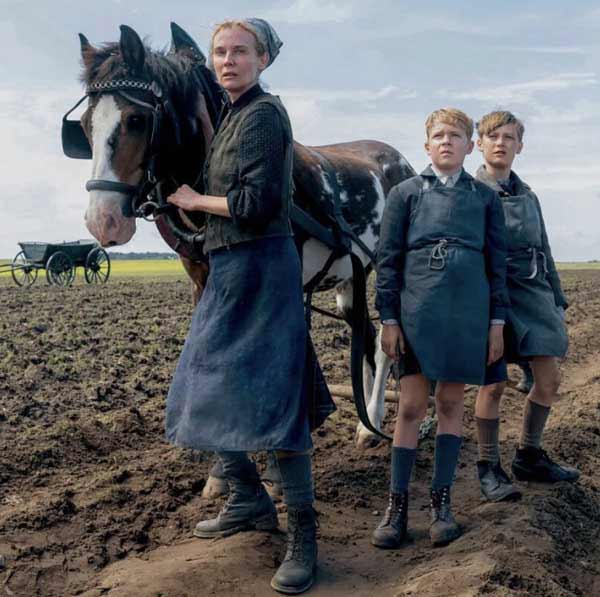
It’s 1945 and Germany is losing the war, but the Nazi apparatus still has enough power for Nanning’s mother (a brutal Laura Tonke) to inform on a local farmer (Diane Kruger, radiant as always) for merely suggesting that the end might be near. “These backstabbers need to be severely punished,” she says, “so others will think twice before doing the same.” Amrum has its own rigid hierarchy of belonging. Native islanders occupy the top rung; people like Nanning, whose families come from Amrum but who were born on the mainland, exist somewhere in the middle; and German refugees displaced by the war occupy the bottom. When Nanning, while at school, joins other students in taunting a group of newly arrived refugees, another boy turns on him: “You’re not an Amrumer either. Get over with them!” In an instant, Nanning discovers that the same hierarchy he’s been helping enforce can just as easily exclude him. Everything changes when it’s announced over the radio that Hitler has died and Nanning’s mother, who has just given birth, sinks into a deep depression and refuses to eat. “All I want is white bread with butter and honey,” she says. And so Nanning sets out to find the ingredients that might restore his mother to health, embarking on a child’s version of the labors of Hercules. Each increasingly harrowing task tests his resilience and awakens a moral instinct neither he nor we knew was there. Director Fatih Akin, whose stunning 2017 thriller “In the Fade” received the Golden Globe for Best Foreign Language Film, gives Nanning’s journey the simplicity of a fable, creating a series of beautifully composed scenes that juxtapose a child’s determination against a crumbling world. And the entire cast give beautifully crafted performances, with Jasper Billerbeck as Nanning embodying each shifting emotion and realization with the open faced honesty of a ten year old mixed with the finesse and depth of an actor decades older.
As a child growing up in the 1970s, fascism was an abstraction, something that had happened long ago to other people in places I’d never visit. Over the past decade or so, that distance has become harder to maintain. Perhaps it was simply naïveté: the comforting assumption that what happened over there, back then, could never reach our front door. Whatever the reason, it’s impossible to watch “Amrum” today as simply a story about the past. Which is part of what makes the film so moving. “Amrum” isn’t interested in tallying guilt or sifting through the rubble for easy lessons. Akin and co-writer Hark Bohm are after something deeper and, ultimately, more hopeful: how does a child begin to unlearn hatred? In “The White Ribbon,” Haneke showed us how cruelty takes root, passed almost imperceptibly from adults to children until it becomes a way of seeing the world. “Amrum” travels in the opposite direction. Through small exchanges between damaged people, unexpected acts of generosity and moments when forgiveness is offered without being earned, Nanning slowly discovers another way of seeing. And like all good fairy tales — and “Amrum” is, at heart, a children’s story — the answer turns out to be remarkably simple. Be kind. STREAMING ON AMAZON PRIME |
|
An LA-based playwright, JUSTIN TANNER has more than twenty produced plays to his credit, including Voice Lessons, Day Drinkers, Space Therapy, Wife Swappers, and Pot Mom, which received the PEN-West Award for Best Play. He has written for the TV shows Gilmore Girls, My So-Called Life and the short-lived Love Monkey. He wrote, directed and edited 88 episodes of the web series Ave 43, available on YouTube. Tanner is the current Playwright in Residence for the Rogue Machine Theatre in Hollywood, where his most recent play My Son the Playwright, of January of 2026, was met with rave reviews. Travis Michael Holder of the LA Drama Critics Circle wrote, "a phenomenal new achievement by local counter-culture hero Justin Tanner.”
|


To receive a free subscription to our Sunday Lounge! newsletter, Click Here
Have a suggestion? Send an email to the Editor, Click Here