





Filmmakers, Screenwriters, Performance, Reviews, Film Reviews, Streaming

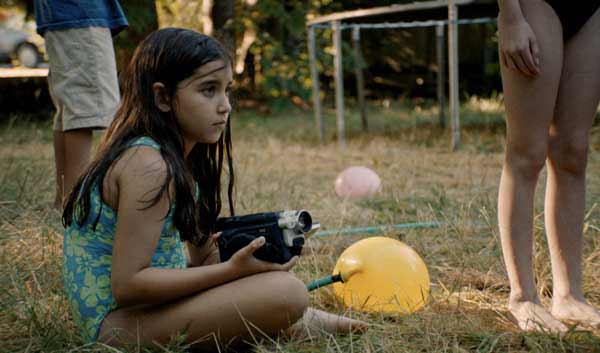
Photo Courtesy of Janus Films
BLUE HERON
by Justin Tanner
I like movies that barely seem aware of my presence. Movies that leave me behind, forcing me to assemble the puzzle instead of handing me the finished picture. Mild confusion is an underrated state of mind. Nothing beats the moment when a film's design suddenly snaps into focus and you realize you got there simply by paying attention. Sophy Romvari's feature debut, "Blue Heron," is just such a film. A strange and marvelous mixture of childhood memoir, documentary, and time-travel fantasy, "Blue Heron" is content to let us drift for much of its running time, unconcerned whether we fully understand what we're seeing. The story follows a family navigating a terrible crisis through the eyes of a young girl named Sasha (Eylul Guven), clearly a stand-in for the filmmaker. By presenting information so gently, Romvari risks losing the audience altogether. More than once I found myself wondering, "Did I really just see that?" only for the next scene to quietly confirm that yes — I had. Rather than becoming frustrating, the uncertainty has the opposite effect. Every glance, every overheard conversation, every seemingly insignificant detail suddenly matters. What gradually emerges is a mystery whose true shape isn't revealed until the film's final devastating moments. From this point on I'll be discussing the film's central revelation, so if you'd rather discover it for yourself, now would be a good time to stop reading.
The film opens with a narrator reflecting on her childhood, recalling, "It's true I spent most of my life being angry at him. The older I get the more I feel like I never even knew him at all." The "him" turns out to be her older brother Jeremy (a blandly terrifying Edik Beddoes), the unstable center around which the entire family revolves. After the credits, we find ourselves inside a lightless U-Haul truck just before the cargo door rolls upward — an image that recalls the darkness-to-light reveal of John Ford's "The Searchers." What follows are a series of snapshots of a family — father, mother, daughter and three sons — settling into their new home on Vancouver Island. Nothing unusual happens. The events are so ordinary they barely register as dramatic. But something feels off. Half-heard telephone conversations, a cryptic argument between the parents, and the subtle way Jeremy's siblings recoil whenever he enters a room begin to reveal a fracture beneath the surface of this otherwise loving family.
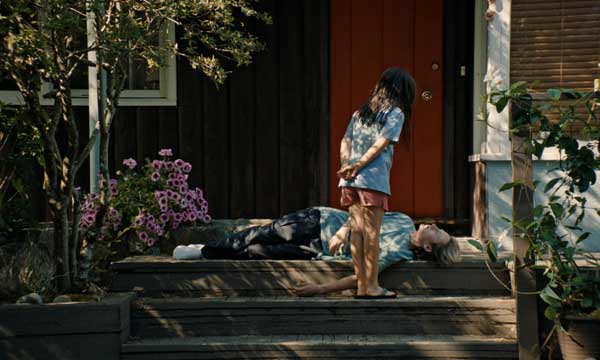
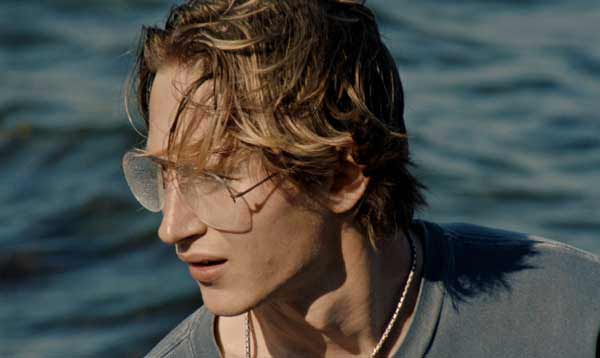
While the father spends his days writing, the mother takes the children on quiet excursions. Ordinary outings gradually become charged with unease as Jeremy's increasingly volatile presence distorts the rhythms of everyday life. It starts small: shoplifting trinkets or disappearing while at the beach and causing a panic — then escalates to lying on the front porch like a corpse for hours, then standing on the roof all day blank eyed and staring until the neighbors call. Next, veiled threats towards his brother at the breakfast table “I don’t wanna watch you eat,” turn into ruining a children’s party by being brought home in handcuffs, to keeping a can of gasoline in his room in case he wants to burn the house down. He enters every room with a purposefully disquieting energy looking for ways to disrupt normal situations until everyone in the house is filled with dread. Beddoes' performance as Jeremy is uncanny and deeply unsettling, capturing the blank-eyed detachment more commonly associated with documentary footage of severe mental illness. With barely a line of dialogue, he dominates every scene simply by existing within it. Jeremy doesn't have to threaten anyone. His mere presence is enough to drain the warmth from a room. It reminded me of Justin Kurzel’s 2021 film “Nitram,” in which Caleb Landry Jones played mass shooter Martin Bryant with similarly unnerving restraint.
Jeremy carries that same sense of imminent catastrophe, as though each scene might be the one where everything finally falls apart. The question facing Jeremy's exhausted parents is painfully simple: what are they supposed to do? Part of what made "Blue Heron" so unsettling for me is how closely Jeremy's behavior mirrored my own as a child. I dissociated at times — once vacuuming the same patch of carpet for nearly an hour while my parents pleaded with me to stop. I shoplifted compulsively, destroyed other people's property for no apparent reason, and sometimes lashed out in ways I couldn't begin to explain. On one occasion I chased my sister through the house with a butcher knife, driving it into the bathroom door after she locked herself inside. The difference is that I eventually grew out of it. Jeremy doesn't. In the second half of "Blue Heron," Romvari makes her boldest creative choice. The film suddenly abandons conventional storytelling altogether, sending us down a series of bewildering narrative detours that seem, at first, to defy explanation. Then, almost imperceptibly, everything falls into place. The revelation isn't simply moving. It's exhilarating, because we've earned it. Romvari's film is already being touted as one of the year's best, and will almost certainly find its way onto dozens of Top Ten lists, mine included. What sets "Blue Heron" apart from something like Charlotte Wells' semi-autobiographical "Aftersun," to which it has frequently been compared, is its underlying warmth. However heartbreaking the material becomes, there's a generosity of spirit running through the film that ultimately transforms sorrow into something life-affirming. Romvari wants to show us the pain and helplessness of loving someone beyond your ability to save. But she also understands that time has a way of softening certainty, replacing anger with compassion and, eventually, transforming memory into art. AVAILABLE FOR RENT AT FANDANGO AT HOME |
|
An LA-based playwright, JUSTIN TANNER has more than twenty produced plays to his credit, including Voice Lessons, Day Drinkers, Space Therapy, Wife Swappers, and Pot Mom, which received the PEN-West Award for Best Play. He has written for the TV shows Gilmore Girls, My So-Called Life and the short-lived Love Monkey. He wrote, directed and edited 88 episodes of the web series Ave 43, available on YouTube. Tanner is the current Playwright in Residence for the Rogue Machine Theatre in Hollywood, where his most recent play My Son the Playwright, of January of 2026, was met with rave reviews. Travis Michael Holder of the LA Drama Critics Circle wrote, "a phenomenal new achievement by local counter-culture hero Justin Tanner.”
|

To receive a free subscription to our Sunday Lounge! newsletter, Click Here
Have a suggestion? Send an email to the Editor, Click Here