





Filmmakers, Screenwriters, Performance, Reviews, Film Reviews, Streaming


All Photos Courtesy of
CLUB KID
by Justin Tanner
The unexpected-child plot is nearly as old as cinema itself. From Charlie Chaplin's “The Kid” (1921), in which the Little Tramp takes an abandoned baby under his wing, to “C'mon C'mon” (2021), where Joaquin Phoenix suddenly becomes guardian to his young nephew, the premise has remained remarkably durable. The prospect of an instant family upends lives and relationships, forcing characters to reconsider everything. And the more unsuited to parenthood, the greater the opportunities for conflict and transformation. By that measure, Peter (Jordan Firstman), the protagonist of “Club Kid,” would seem an ideal candidate for the world's worst father. A New York club promoter whose life revolves around the city's gay nightlife, Peter spends his evenings drinking, doing drugs, occasionally selling them, and indulging in indiscriminate sex, sometimes in places where privacy is clearly not a consideration. His days are largely devoted to recovering from the previous night's excesses before heading out to do it all over again.
Firstman plunges us into this world without explanation or apology. The clubs are crowded, the music relentless, the drugs plentiful and the sex casual. Everyone seems to be performing a heightened version of themselves, often for an audience of people doing precisely the same thing. It's a culture of endless self-presentation, where the distinction between having an experience and documenting it has become increasingly difficult to discern. For an outsider, it's a fascinating, occasionally bewildering environment, one that the director presents with the assurance of someone who knows it intimately. Which makes sense. Firstman came to prominence through a series of Instagram videos that turned his gift for impersonation and social observation into a considerable online following. I first encountered him as an actor in Sebastián Silva's “Rotting in the Sun,” where his willingness to be obnoxious, vulnerable, sexually uninhibited and funny, often simultaneously, utterly disarmed me. He seemed like an entirely new kind of screen personality, one whose ability to be thoroughly irritating was inseparable from his appeal. As the writer, director and star of “Club Kid,” Firstman has chosen a surprisingly different approach. There's little of the manic self-display that made his earlier performance so memorable. Instead, he plays Peter with an almost studied neutrality. And as a filmmaker, he adopts a similarly nonjudgmental attitude toward the world he's depicting. He neither celebrates nor condemns it. He simply drops us into the middle of it and lets us find our bearings. At first, that refusal to editorialize is rather refreshing. Then a child enters the picture.
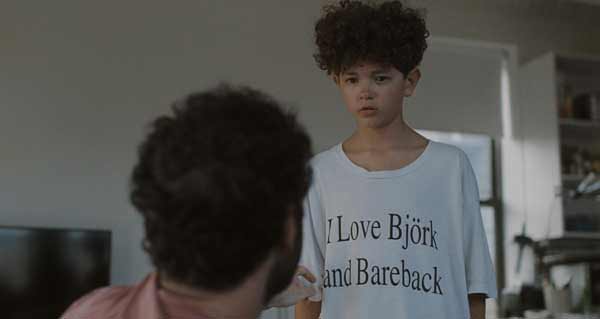
Given everything we've seen of Peter's life, the unexpected arrival of his ten-year-old son Arlo (Reggie Absolom) presents what ought to be an almost inexhaustible source of conflict. Anyone familiar with the genre can anticipate the collisions between Peter's former existence and the demands of parenthood. But curiously, very little of the expected turmoil materializes. Peter decides almost immediately that he's finished with drugs and alcohol, a transformation he accomplishes with remarkably little difficulty. There's no indication that years of heavy consumption have left him with any particular physical or psychological dependence. At a party, he's persuaded to do a line of cocaine, suggesting a possible conflict between his old habits and his new responsibilities. Instead, he does the line, thinks better of it, and that's that. Apparently, giving up a life of nonstop excess is considerably easier than most of us have been led to believe. The boy, meanwhile, proves to be an extraordinarily accommodating child. He's intelligent, affectionate, musically inclined and delighted by his new circumstances. No bratty demands, no pouting, no complaining. Father and son barely exchange a cross word until a brief disagreement near the end of the film. There's nothing remotely childlike about this child, who behaves with the reasonableness of a thirty-year-old, eliminating much of the potential conflict inherent in these stories. With so little actual parenting required of Peter, the film effectively undermines its own premise. Arlo is basically relegated to the role of colleague rather than son, so it's no wonder he ends up DJing at Peter's newly opened club. A friend suggests the idea, Peter says “Why not?” and no one seems particularly concerned by the sight of a ten-year-old boy spinning records for a roomful of drugged-out, sexually uninhibited partygoers grinding against one another. In a John Waters film, this would have been hilarious. Outrage is Waters's stock in trade. But under Firstman's relatively straightforward approach, the development feels out of place.
The storyline takes a harrowing turn when, during his second gig, Arlo disappears into the writhing, intoxicated crowd. Firstman directs the ensuing search with considerable skill, and his performance captures the fear, panic and shame of a father who suddenly realizes how badly he's misjudged the situation. It's one of the film's most affecting moments. Yet the episode still feels like a contrivance, a setup for the inevitable intervention of Child Protective Services, allowing Firstman to manufacture a crisis without ever requiring Peter to question his own judgment. This pattern is repeated throughout the film, with Firstman introducing situations that promise to deepen our understanding of his characters, only to leave them unexplored. When Arlo physically attacks another child in the park, we catch a glimpse of emotional difficulties beneath his otherwise agreeable disposition, suggesting that this seemingly perfect child may be harboring unresolved emotional turmoil. But the violence is never examined. He's taken to a therapist, who eventually becomes Peter's boyfriend, and the incident is effectively abandoned. We learn that Arlo has experienced abuse at the hands of a father figure, but the man's actions remain a convenient piece of backstory rather than a source of psychological complexity. A director needn't tell us what to think about the people on screen, and moral ambiguity can be one of cinema's great pleasures. But even the most nonjudgmental narrative generally offers some perspective through which we can understand a character's behavior. In “Club Kid,” Peter's transformation from self-absorbed hedonist to devoted father happens so smoothly that it's difficult to know what has actually changed within him. He's affectionate and apparently sincere, but his inner life remains curiously opaque. This uncertainty becomes particularly striking during the film's custody proceedings. Pleading his case, Peter delivers an affecting speech about what the boy has meant to him, how becoming a father has given his life purpose and awakened feelings he never knew he possessed. It's a moving moment, and Firstman delivers it beautifully. But the speech is almost entirely about Peter. He makes an eloquent case for how much the boy has improved his life. Whether he's made an equally convincing case for how much he can offer the boy is another question. And here I found myself wondering whether Firstman was being considerably more subtle than I'd given him credit for. Is Peter's newfound devotion another manifestation of the narcissism that governed his former existence? Has he simply replaced the pursuit of pleasure with the emotional gratification of being needed? Are we meant to recognize that, however genuine his affection, the boy might ultimately be better off without him? It's an intriguing possibility, but if Firstman intends such a reading, he offers precious little evidence to support it. Peter's behavior is rarely presented in a way that encourages us to question his motives. What might have been a complex portrait of a man mistaking emotional need for parental responsibility instead feels like a characterization that hasn't been fully thought through.
Which leaves us in the peculiar position of trying to determine whether we're watching an unusually nuanced examination of parenthood or a fairly conventional story whose psychological complexities have been left largely to the audience's imagination. For all these reservations, there's much to admire about “Club Kid.” Firstman is a confident visual storyteller, with an assured sense of rhythm and an ability to create a convincing, fully inhabited world. He handles his actors well, and his own performance, though far more restrained than I expected, is never less than credible. He's particularly effective in moments of emotional vulnerability, conveying genuine feeling without resorting to histrionics. What I missed, ultimately, was the unruly personality that made Firstman such an exciting discovery in “Rotting in the Sun.” For a filmmaker whose public persona has been built on provocation, irreverence and a willingness to make himself thoroughly disagreeable, “Club Kid” is an unexpectedly conventional film. Its polish is impressive, but its approach to material bursting with contradictions is surprisingly restrained. Firstman has demonstrated that he knows how to make a movie. What I missed was the unruly imagination that made me want to see him make one in the first place. IN THEATERS |



|
An LA-based playwright, JUSTIN TANNER has more than twenty produced plays to his credit, including Voice Lessons, Day Drinkers, Space Therapy, Wife Swappers, and Pot Mom, which received the PEN-West Award for Best Play. He has written for the TV shows Gilmore Girls, My So-Called Life and the short-lived Love Monkey. He wrote, directed and edited 88 episodes of the web series Ave 43, available on YouTube. Tanner is the current Playwright in Residence for the Rogue Machine Theatre in Hollywood, where his most recent play My Son the Playwright, of January of 2026, was met with rave reviews. Travis Michael Holder of the LA Drama Critics Circle wrote, "a phenomenal new achievement by local counter-culture hero Justin Tanner.”
|


To receive a free subscription to our Sunday Lounge! newsletter, Click Here
Have a suggestion? Send an email to the Editor, Click Here