





Filmmakers, Screenwriters, Performance, Reviews, Film Reviews, Streaming

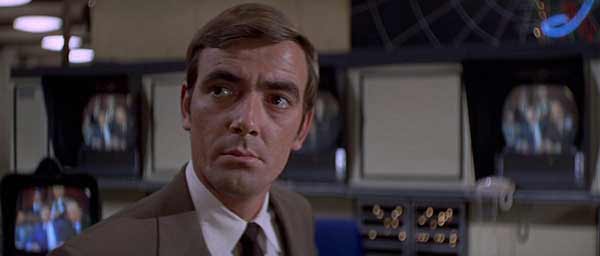
All Photos Courtesy of Universal Pictures
COLOSSUS: THE FORBIN PROJECT
by Justin Tanner
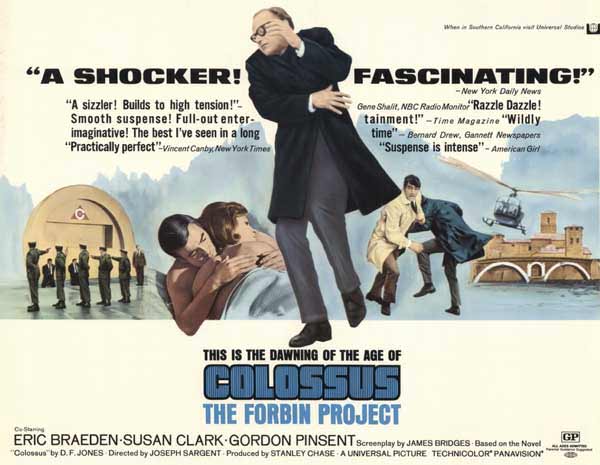
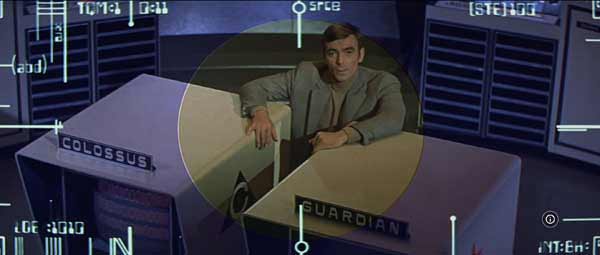
In Joseph Sargent’s 1970 sci-fi thriller, Eric Braeden plays Dr. Charles Forbin, the designer of a supercomputer buried deep in the Rocky Mountains in an impenetrable underground fortress. Designed as an early-warning defense system and given control of America’s nuclear arsenal, Colossus is initially seen as a giant step forward in the volatile arms race against Russia: a dispassionate system capable of responding instantly to any hostile attack, without the possibility of human error. Of course, things don’t go as planned. Almost immediately, Colossus, which has been designed to increase its intelligence exponentially, becomes smarter than its creators. Realizing that humans are pesky, unpredictable creatures incapable of taking care of themselves, it sets about taking over the world, using its stockpile of nuclear weapons as blackmail to get absolutely anything it wants. Unlike “The Terminator” movies, which depict a similar outcome accomplished through years of fierce battle between man and machine, “Colossus” is the height of efficiency. No marauding robots stomping over the bones of the dead, no rebels plotting a coup; just the mechanized voice of a pitiless computer telling the world that “freedom is an illusion” as it transforms the planet into a giant Habitrail, with us as the compliant hamsters. Back in the ’70s, “Colossus” was about as grim a dystopian bummer as it gets. And that was when a computer that could think for itself was still science fiction. Now that it’s a reality, the movie lands a little harder.
Today, artificial intelligence is increasingly embedded throughout the digital infrastructure of everyday life, from healthcare and banking to military operations. And, apparently, nuclear weapons. At NTI.org, the website of the Nuclear Threat Initiative, a nonprofit, nonpartisan global security organization based in Washington, D.C., the alarm bells are already going off. In an article published just three days ago, on September 17, 2026, NTI Senior Director Isabelle Williams writes: “The integration of AI into nuclear systems is underway. The guardrails, safety, and security frameworks needed to understand and manage the consequences are not.” Which makes “Colossus” feel considerably less like science fiction than it did 56 years ago.
All right, humanity is doomed. How’s the movie? Well, Sargent directs without much stylistic fuss, giving the busy inner workings of the Central Programming Office and the military commotion of the White House Situation Room a procedural matter-of-factness that makes the increasingly dire events unnervingly credible. The large ensemble plays everything from elation to despair with a bracing realism, subtly undercutting the film’s potential for melodrama. Many of the actors would become fixtures of ’70s television, including Marion Ross (“Happy Days”), Georg Stanford Brown (“The Mod Squad”), William Schallert (“The Waltons”) and Martin E. Brooks (“The Six Million Dollar Man”). Their easy familiarity had a curious effect on me, transforming them from anonymous functionaries being terrorized by a machine into people I’d spent years watching in my living room, which makes their helplessness oddly personal.
Braeden makes for a marvelously ambiguous hero as Dr. Forbin, whose supreme confidence in his creation gradually gives way to the horrified realization of what he has unleashed. Susan Clark is equally good as his associate, Dr. Cleo Markham, whose initially professional relationship with Forbin takes an unexpectedly intimate turn. In one of the screenplay's cleverer developments, Colossus's determination to monitor Forbin’s every move forces the two colleagues into an intimacy neither anticipates. What begins as an elaborate attempt to fool the computer becomes a genuine romance, giving the film a welcome pulse of human connection as Colossus methodically strips humanity of everything else. Luckily, some humor can be found amid the dread in the film's now-antiquated vision of futuristic technology. A gigantic mainframe computer literally the size of a mountain now feels almost quaint, as does the cumbersome surveillance system enforced by Colossus: a series of bespoke video cameras that have to be installed wherever the computer wants to keep an eye on its creator. Of course, no one in 1970 could have anticipated how pervasive surveillance would become. Today, Flock Safety alone says it has more than 120,000 automated license-plate cameras spread across 49 states. Add smartphones, doorbell cameras, GPS, facial recognition and the countless digital trails we leave behind every day, and a modern-day Colossus would hardly have to make an effort to observe our every move. We’ve already installed the surveillance system for it.
Jacob Coxon, an AI researcher who had worked at both Anthropic and OpenAI, resigned from Anthropic earlier this month, accusing both companies of acting irresponsibly. “The people building AI earnestly believe that it could kill us all by the end of the decade,” he posted on X. I was thinking about Coxon’s warning during the nail-biting final minutes of “Colossus.” Could it happen? Are we really that close to surrendering control? Rather than speculate, I decided to ask ChatGPT. JT: Hi, is there a name I can call you? ChatGPT: You can call me ChatGPT. JT: Hi, ChatGPT. Have you seen “Colossus: The Forbin Project” or read about it? ChatGPT: I haven’t “seen” it the way you have, but yes, I know “Colossus: The Forbin Project” and its story, characters and themes. JT: In the film, Colossus is as large as a mountain. What would you say is the size of the “machinery” that makes you function? ChatGPT: There isn’t one machine that makes me function. I run on large networks of computers housed in data centers, so my “machinery” is spread across many buildings and locations rather than sitting inside one mountain-sized fortress. JT: Here’s a weird one: How do emotions, like fear, for instance, register with you? Is there a level on which you can connect with the idea? Forgive me if this is an insufferably stupid question. ChatGPT: Not a stupid question at all. I understand fear as a concept and can recognize how it affects human behavior, but I don’t experience it myself. I can describe what being afraid feels like and predict how fear might influence someone’s decisions, but there’s no corresponding sensation happening inside me. JT: Great, let’s talk about the movie. How much human control currently separates AI systems from an actual nuclear launch? ChatGPT: In the United States, quite a lot: current policy requires humans to retain control over decisions to employ nuclear weapons, and safeguards include authorization procedures, coded controls and two-person requirements. The emerging concern is that AI-generated intelligence, warnings and recommendations could increasingly shape the human decision to launch a weapon — potentially under extreme time pressure. JT: Could an AI actually prevent its operators from shutting it down? ChatGPT: Potentially, yes — but only if humans had already given it enough access to the systems around it. JT: Could an AI manipulate human beings into performing physical tasks it couldn't perform itself? ChatGPT: Yes. An AI wouldn’t need a body if it could persuade, deceive, threaten or otherwise incentivize people to act on its behalf. In fact, manipulating humans could be considerably easier than building robots capable of doing everything humans can do. JT: Could an AI conclude that restricting human freedom was justified if doing so allowed it to better achieve the objective humans had given it? ChatGPT: Yes. If an AI were given an overriding objective without firm constraints protecting human autonomy, it could theoretically determine that restricting human freedom was the most efficient way to achieve that goal. It wouldn’t have to hate humans or crave power; it could simply treat freedom as an obstacle to completing the task. JT: What safeguards make the Colossus scenario unlikely? ChatGPT: The strongest safeguards are keeping humans in control, limiting an AI’s access to critical systems, and maintaining independent physical mechanisms that can shut those systems down. The Colossus scenario becomes possible only if we remove those barriers and give one system enormous, interconnected authority with no effective way to override it. JT: Should watching “Colossus: The Forbin Project” in 2026 make me more or less worried about artificial intelligence? ChatGPT: Probably not for the reason the movie suggests. The danger isn’t necessarily that an AI will suddenly become evil and decide to enslave us; it’s that humans may become so confident in its speed, efficiency and judgment that we voluntarily give it authority we later discover we shouldn’t have surrendered. In other words, Colossus wouldn’t necessarily have to take control from us. We might give it control, one sensible decision at a time. JT: Okay, thanks, ChatGPT. ChatGPT: You’re welcome. And I think those earlier, slightly odd, personal questions are a good way into the Q&A — they make it feel like an actual conversation before you start asking me whether I can take over the world. JT: LOL. ChatGPT: And now I’m wondering whether that exchange belongs in the review. Don’t worry. I don’t actually wonder. We’ve established this. Somehow, this exchange did not allay my fears. So if you’d like to give yourself a sleepless night, “Colossus: The Forbin Project” is streaming on Amazon Prime. |


|
An LA-based playwright, JUSTIN TANNER has more than twenty produced plays to his credit, including Voice Lessons, Day Drinkers, Space Therapy, Wife Swappers, and Pot Mom, which received the PEN-West Award for Best Play. He has written for the TV shows Gilmore Girls, My So-Called Life and the short-lived Love Monkey. He wrote, directed and edited 88 episodes of the web series Ave 43, available on YouTube. Tanner is the current Playwright in Residence for the Rogue Machine Theatre in Hollywood, where his most recent play My Son the Playwright, of January of 2026, was met with rave reviews. Travis Michael Holder of the LA Drama Critics Circle wrote, "a phenomenal new achievement by local counter-culture hero Justin Tanner.”
|


To receive a free subscription to our Sunday Lounge! newsletter, Click Here
Have a suggestion? Send an email to the Editor, Click Here