





Filmmakers, Screenwriters, Performance, Reviews, Film Reviews, Streaming

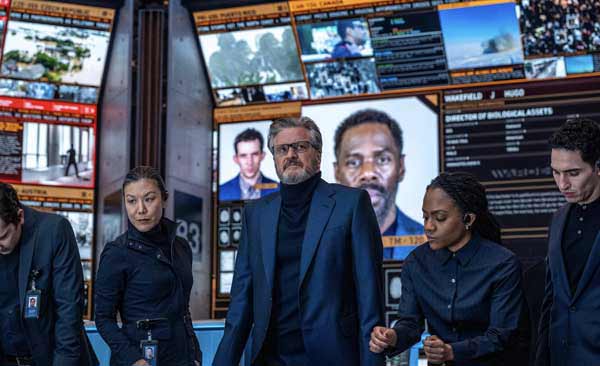
All Photos Courtesy of Universal Pictures
DISCLOSURE DAY
by Justin Tanner
Back in June, I headed to the Paseo Regal in Pasadena fully intending to see Spielberg's latest film for review, but on my way there, I decided I just couldn't put myself through it. Not very professional of me, I know, but watching Steven Spielberg's movies has become something of a cinematic chore. His last two films, “West Side Story” and “The Fabelmans,” reinforced all the reasons I've been wary of his work for the last thirty years: an obviousness so relentless that shutting down becomes almost inevitable. In my review of “The Fabelmans,” I tried to get to the root of the problem: “Spielberg simply doesn't think his audience is capable of unassisted thought, so he's constantly nudging the movie along with bludgeoning 'hints' about what we're seeing, waving his hands and pointing like an over-caffeinated mother trying to get baby's attention.” It wasn't always this way.
My first encounter with Spielberg came when I was five, watching “Duel” on television with my family. I still remember the terror of that enormous truck pursuing poor Dennis Weaver through the desert. But it was his next film, “Something Evil,” that became one of the seminal viewing experiences of my childhood. I was six when it first aired, and for some reason I ended up watching it alone. Sandy Dennis and Darren McGavin play a married couple with two young children who buy a farmhouse in rural Pennsylvania, only to discover that it's inhabited by a demonic presence. Two images have stayed with me for more than fifty years. The first is a glass canning jar containing a reddish, glowing glob of protoplasm that undulates and cries like a baby. The second is Sandy Dennis, possessed by the devil, beating the crap out of her ten-year-old son. The boy was named Stephen, which also happened to be my name at the time. I'd experienced physical abuse myself, and the scene in which the mother repeatedly screams her son's name before chasing him down and beating him was extremely upsetting. Back then, Spielberg wasn't interested in reassuring us. His characters were frightened, angry, sometimes cruel, and their homes were hardly sanctuaries. In “Close Encounters of the Third Kind,” Roy (Richard Dreyfuss) becomes obsessed with finding aliens, while his wife Ronnie (Teri Garr) struggles with a husband who's abandoned his responsibilities as a father. Both positions are understandable, and Spielberg trusts his actors to reveal the conflict through behavior rather than explanation. The scene in which Roy's son discovers him sobbing in the shower and repeatedly calls him a crybaby is a heartbreaking depiction of paternal humiliation. And Roy's eventual abandonment of his family becomes a poignant metaphor for the artist compelled to pursue his vision, whatever the cost. For me, Spielberg has never reached those emotional depths again, not even in supposedly more adult films like “Schindler's List.” I still consider “Close Encounters” the most daring film he's ever made. His edge softened during the eighties and, by the 2000s, seemed to have vanished entirely. Perhaps the most telling example is his decision to digitally remove the guns from the federal agents' hands in the twentieth-anniversary rerelease of “E.T.” It's a small but revealing alteration: a filmmaker who once understood the power of danger was now trying to protect his audience from it. And yet his reputation has only grown, so I keep returning to his films, hoping to discover what I'm apparently missing.
I watched “Disclosure Day” twice this week. The first time, I let all 145 minutes wash over me. The second, I stopped whenever something struck me and wrote it down. By the end, I'd accumulated eighteen handwritten pages of notes. The film opens with its most surprising image: a foot literally kicking us in the face. We're in a wrestling ring, Spielberg's camera planted on the mat, looking up as pro wrestler Brian Cage stomps down on it. The scene involves a hostage exchange, inexplicably arranged in the middle of a wrestling match. The kick becomes an apt metaphor for a movie that spends the next two-plus hours trying to stomp us into submission. It also illustrates a fundamental flaw in Spielberg's approach: there's no reason to stage the exchange in a wrestling ring except that Spielberg happens to be a fan. The action almost immediately moves to an adjoining parking lot, a far more sensible location for a hostage exchange. But Spielberg wants to kick us in the face, and the screenplay will do whatever it takes to get his foot there. This is the organizing principle of “Disclosure Day.” The effect comes first, and everything else is reverse-engineered to accommodate it. Complications arise not from the characters or their circumstances, but whenever the screenplay needs another burst of activity. Whether any of it makes sense hardly matters.
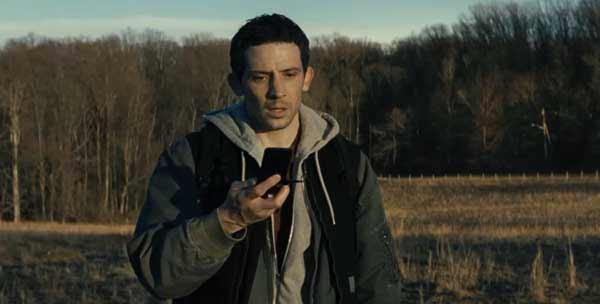
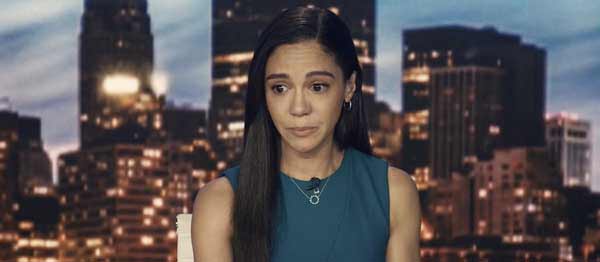
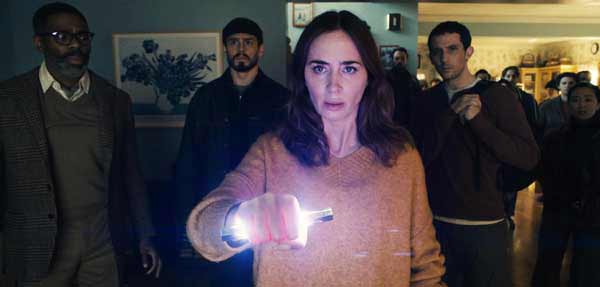
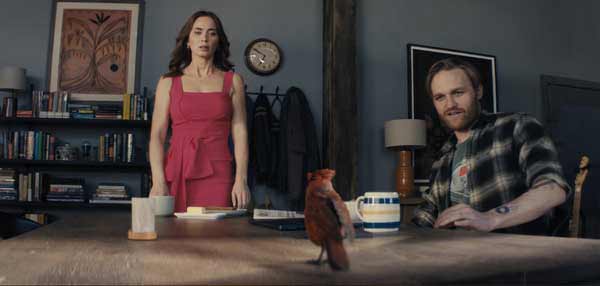
The plot, such as it is, features Josh O'Connor as Dr. Daniel Kelner, a former employee of a shadowy government organization who has stolen a mysterious device: proof that extraterrestrial life exists. What follows is a series of nearly interchangeable chases, captures and escapes. It's like a CD featuring one decent song and eight increasingly uninteresting remixes. By the time we've heard them all, we never want to hear the original again. While Daniel runs around with his stolen alien what's-it, Margaret Fairchild (Emily Blunt, looking embarrassed), a television weather reporter, begins experiencing strange phenomena after a bird flies through her apartment window and stares at her. (Animals do a lot of inexplicable staring in “Disclosure Day.”) Suddenly she can speak Russian and read people's minds. Though her boyfriend witnesses this extraordinary behavior, he decides she's crazy and needs to be hospitalized. Not because he's particularly suspicious or psychologically complicated, but because somebody needs to become an antagonist. Blunt, one of the most reliable actors working in film, has been given a thankless assignment. How do you convincingly play someone who discovers she has otherworldly powers, then shrugs and goes about her day? A believable reaction would derail the plot, so Margaret, like everyone else, behaves like a puppet, moving wherever the increasingly silly screenplay needs her. Typical of Spielberg's recent work, the dialogue sounds less like a conversation than a series of flash cards held up for our benefit. When Daniel and his girlfriend (the hostage from the opening scene) seek refuge at a convent, he asks how she knows the nuns will answer the door. Why on earth wouldn't they? She replies, “Because that's what we do,” revealing that she used to be a nun. It's certainly economical storytelling, but the contrivance is so glaring that the film almost feels postmodern. And we're constantly being told things we already know. “This is the most significant security lapse in your organization's history,” a character announces, apparently for the benefit of viewers who slept through the first hour. Spielberg doesn't merely underline information. He circles it, highlights it, reads it aloud and then asks if we're absolutely sure we've understood. Even suspense must be explained in advance. The villains repeatedly announce what they're just about to do, robbing us of the pleasure of discovery. Consequently, we're miles ahead of the film every step of the way. It's like walking to the store with your little brother, who keeps falling two blocks behind. You stop, turn around and tell him to hurry up. He catches up, you resume walking, and a minute later he's lagging behind again. Eventually you want to throttle him. The alien what's-it is a particularly convenient piece of equipment. Its capabilities seem limited only by the needs of the current scene. It can manipulate minds, translate languages, teleport people, render them invisible and generate power. Then, when the screenplay requires another narrow escape, its batteries suddenly start running low, allowing the whole tiresome process to begin again. At times, the film seems assembled from discarded parts of other, better movies. The backdrop of impending war between the United States and Russia, conveyed through ominous news broadcasts, recalls James Cameron's “The Abyss,” where the possibility of global catastrophe creates a palpable atmosphere of dread. Here, the threat seems almost entirely theoretical. Characters behave as though the world might be ending, provided it doesn't interfere with their afternoon plans. Margaret's frantic arrival at the television station recalls Jane Fonda's entrance in “The China Syndrome,” while her endless mind-reading demonstrations evoke Christopher Walken in “The Dead Zone.” The images are familiar, but the dramatic contexts that gave them meaning have disappeared. It's like looking at a facsimile of a copy of a Polaroid of a hand-drawn picture. And yet, buried in this vast emptiness, there are occasional reminders of what Spielberg can do. Classified footage of an alien being tortured is genuinely upsetting and provides the film's first comprehensible motivation. Daniel's discovery of the footage prompted him to break with the organization and expose its secrets. For once, a character's actions arise from a recognizable human response rather than the arbitrary demands of the plot. Then, near the end, Spielberg's command of editing, composition and visual rhythm finally comes together, reminding us why he has a reputation for cinematic mastery. When the classified footage of extraterrestrial existence is broadcast, other stations pick it up, and the news spreads around the world. People gather around televisions and stare at their phones, united in silence as they witness this life-changing event. For a moment, “Disclosure Day” becomes the movie it has been promising to be. The footage is compelling, but the real revelation is Courtney Grace, playing a newscaster who witnesses the unfolding disclosure along with the rest of the world. Grace is astonishingly convincing, balancing professionalism with an emotional awe that draws us into the moment. “My God, this is extraordinary,” she says. On paper, it's hardly a remarkable line. But Grace makes it remarkable because we believe her. For the first time in more than two hours, we believe the movie, too. Something similar happened at the end of “The Fabelmans,” when David Lynch appeared as John Ford and delivered his wonderfully eccentric lesson on cinematic composition. For a few moments, a movie I'd found almost unbearably self-satisfied came alive with wit, surprise and genuine cinematic intelligence. Here, too, Spielberg briefly reminds us why he became Spielberg. Which makes the ending all the more infuriating.
After more than two hours, the film finally brings Margaret face-to-face with an actual alien. It's a creature she encountered as a child, and their reunion is presented as the culmination of everything we've been watching. The alien reaches toward her, places its hands on either side of her head and draws her close. And I thought: Oh my God. It's going to bite her head off. For one glorious second, I imagined Spielberg doing something genuinely outrageous. After spending the entire movie making certain that no one could possibly be surprised, he was finally going to pull the rug out from under the audience. Had the alien bitten off her head and Spielberg cut to black, I might have forgiven the entire movie. Instead, the creature whispers something in her ear. Margaret becomes emotional, turns toward the camera and prepares to deliver a message from the aliens to humanity. “Listen,”she says. And that's where the movie ends. Spielberg concludes by withholding the one piece of information that might actually justify the exercise. To end by announcing that there is a message, then refusing to tell us what it is, feels less like artistic ambiguity than a practical joke played on an audience that's already paid for the privilege of being kicked in the face. AVAILABLE TO RENT ON AMAZON PRIME |
|
An LA-based playwright, JUSTIN TANNER has more than twenty produced plays to his credit, including Voice Lessons, Day Drinkers, Space Therapy, Wife Swappers, and Pot Mom, which received the PEN-West Award for Best Play. He has written for the TV shows Gilmore Girls, My So-Called Life and the short-lived Love Monkey. He wrote, directed and edited 88 episodes of the web series Ave 43, available on YouTube. Tanner is the current Playwright in Residence for the Rogue Machine Theatre in Hollywood, where his most recent play My Son the Playwright, of January of 2026, was met with rave reviews. Travis Michael Holder of the LA Drama Critics Circle wrote, "a phenomenal new achievement by local counter-culture hero Justin Tanner.”
|


To receive a free subscription to our Sunday Lounge! newsletter, Click Here
Have a suggestion? Send an email to the Editor, Click Here