





Filmmakers, Screenwriters, Performance, Reviews, Film Reviews, Streaming

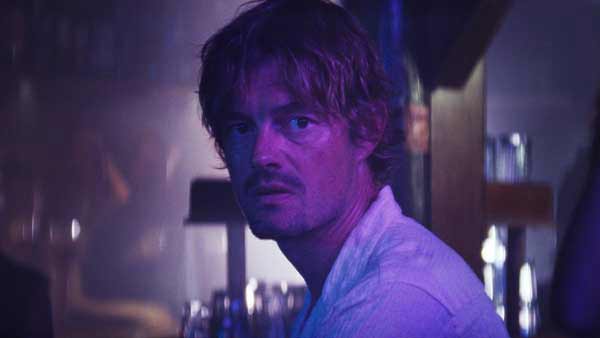
Photo Courtesy of Greenwich Entertainment
ISLANDS
by Justin Tanner
"Islands" director Jan-Ole Gerster introduces us to his protagonist, Tom — wonderfully inhabited by Sam Riley in a perpetual state of hangover — half-naked and unconscious in the middle of a sand dune. Bathed in the pale light of dawn, he could easily be mistaken for a corpse. Only the slightest movement reveals he's still alive. Hours later, he locates his car and drives to work at a sprawling beach resort on Fuerteventura in Spain's Canary Islands. "You look rough," a co-worker remarks as Tom staggers up to the front desk. It's an understatement. Sunburned face, puffy eyes, oily skin, stringy hair shoved beneath a backwards baseball cap — he looks less like an employee than someone security ought to escort off the premises. The exchange also makes it clear this is nothing new. His days are spent recovering from the night before while giving tennis lessons to wealthy vacationers. His nights disappear into the strobe-lit chaos of the Waikiki nightclub, where he drinks heavily, procures drugs for hotel guests, and stumbles into anonymous sexual encounters. By morning he's back at the resort, taking a long pull from a bottle of bourbon hidden in the pro shop before stepping onto the court to do it all again. Tom belongs to a long line of noir protagonists: men living on the edge of dissolution, one bad decision away from going under. Gerster sets all this in motion with wry restraint, aided immeasurably by cinematographer Juan C. Sarmiento Grisales' sun-drenched vistas and warm interiors.
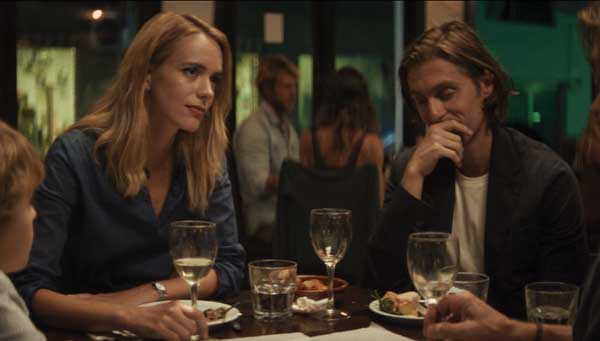
Then, with almost no fanfare, the plot changes shape. One day a bus pulls up to the hotel and a handsome couple, along with their seven-year-old son, step off. Oddly, Tom is already standing nearby, almost as though he's been waiting for them. As Anne, a slender blonde played with icy precision by Stacy Martin, descends the steps, she locks eyes with Tom. He pauses mid-drag on his cigarette while Dascha Dauenhauer's lush score swells expectantly. Everything about the moment suggests we're on the verge of a revelation. Instead, Gerster cuts away. Do these two know each other? Is the film planting clues, or merely inviting us to think it is? Many of those questions aren't answered until much later — if they're answered at all. How much that appeals to you will depend on your tolerance for ambiguity. Personally, I found it invigorating. Gerster is playing a longer game than the sunny resort noir the film initially appears to promise. An unmistakable melancholy hangs over the story, along with the suspicion that Tom's loneliness may be creating patterns where none exist. The mystery becomes less about discovering the truth than understanding why Tom needs there to be one. Meanwhile, all the essential noir ingredients make an appearance: chiaroscuro lighting, a femme fatale with a secret, a controlling husband with a dangerous plan, a dogged detective, a disappearance, a double (perhaps even triple) cross, and enough narrative misdirection to keep us questioning what's real almost until the final frame.
And Gerster casually plants seemingly insignificant details — the husband's fascination with volcanoes, a camel ranch owned by Tom's friends, even the fact that Tom once beat Rafael Nadal as a young tennis player — only to have them resurface in unexpected ways. What first appears to be aimless drift gradually reveals itself as something much more carefully designed. Or does it? Near the end I became convinced the film had been lying all along and found myself questioning not only Tom's interpretation of events, but Gerster's as well — a strategy reminiscent of Hitchcock's "Stage Fright." Sam Riley and Stacy Martin are terrific as the would-be lovers, playing every step of their dance so close to the vest it's hard to know what either is thinking. Jack Farthing, meanwhile, supplies a welcome streak of humor as Dave, Anne's boorish husband, a man so relentlessly irritating you spend the entire film waiting for something terrible to happen to him. When he ignores Tom's warning and wanders into a darkened cave, his horrified shriek is one of the film's funniest moments, equal parts shock and comic comeuppance. By the time the film fades to black, bringing with it one final shift in perspective, what lingers is the beauty of the images more than the mechanics of the plot. D.P. Sarmiento Grisales composes nearly every frame as though it were meant to be hung on a wall: sunlight shimmering across sand, the melancholy debris of a hotel room after another anonymous night, figures dwarfed by desolate landscapes. Most unforgettable is the image of a helicopter lifting a body from the ocean while tiny, shadowed figures watch from a distant cliff. It captures everything Gerster has been building toward: beauty, isolation, and nature's unsettling indifference to human drama. The sea has rarely looked so simultaneously beautiful and apocalyptic. AVAILABLE TO RENT FROM AMAZON PRIME |

|
An LA-based playwright, JUSTIN TANNER has more than twenty produced plays to his credit, including Voice Lessons, Day Drinkers, Space Therapy, Wife Swappers, and Pot Mom, which received the PEN-West Award for Best Play. He has written for the TV shows Gilmore Girls, My So-Called Life and the short-lived Love Monkey. He wrote, directed and edited 88 episodes of the web series Ave 43, available on YouTube. Tanner is the current Playwright in Residence for the Rogue Machine Theatre in Hollywood, where his most recent play My Son the Playwright, of January of 2026, was met with rave reviews. Travis Michael Holder of the LA Drama Critics Circle wrote, "a phenomenal new achievement by local counter-culture hero Justin Tanner.”
|


To receive a free subscription to our Sunday Lounge! newsletter, Click Here
Have a suggestion? Send an email to the Editor, Click Here