





Filmmakers, Screenwriters, Performance, Reviews, Film Reviews, Streaming

All Photos Courtesy of Maslow Entertainment
LEVITICUS
by Justin Tanner
Back during the COVID lockdown, when it was just my husband, two cats and me, and the rest of the world seemed impossibly distant, I decided to try an experiment. For three months, I would watch only gay films. I wanted to see if I could somehow reprogram the heteronormative idea of love, sex, and coupling that had been fed to me my entire life and replace it with queer imagery. Could I stop seeing gay romance as the also-ran and make it, at least inside my own head, the cultural default? There was a certain absurdity to the idea, but I committed to it. Over the next three months, I watched nearly a hundred films. Some good, a lot bad, and a few genuine masterpieces: the exquisite “God's Own Country,” the brutal “Head On,” the politically charged “BPM,” the heartbreaking “I Am Jonas,” the theatrically punk “Strapped,” and the sexually frank “Paris 05:59.” Eventually a narrative pattern emerged, a variation on the old Victorian marriage plot, where the path to love was thwarted by economic disparity or family disapproval. Here, queerness became the obstacle: Two men meet, one more comfortable with his sexuality than the other. They have sex. The frightened one recoils. And, after enough longing and suffering, they find their way back to each other. Then the conflict shifts to the world around them. Their relationship must be hidden until, inevitably, they're discovered and the closeted man is forced to choose between his family and the man he loves. Sometimes this ended happily; frequently it ended in tragedy.
But as cultural acceptance — or at least tolerance — of queerness grew, another type of gay story emerged. These films shed some of the old narrative requirements. Gay characters could finally have problems that weren't exclusively about being gay. Movies such as “Bros,” “Spoiler Alert” and “Fire Island” took familiar romantic-comedy structures, populated them with gay characters and left it at that. The closet no longer had to be the engine of the plot. The films of Argentine director Marco Berger, which I discovered during my deep dive, took this evolution even further: their slow-burn romances demonstrate that gay desire doesn't need homophobia to generate suspense. In his films, the obstacle is often simply the maddening inability of two men to acknowledge what is already obvious to everyone watching. In “Hawaii,” for instance, a young man goes to work for an old friend, now a professor. Over the course of the film, we discover that both men are living in states of isolation and uncertainty, continually missing the cues that might accelerate their attraction. Because neither is willing to make the first move, they swim, work, eat, and talk, often within inches of each other, with a palpable sensuality buzzing between them like a live wire. As we wait for something, anything, to happen, the tension becomes almost unbearable. Our investment isn't merely in seeing them have sex. We desperately want these two lonely men to find their way to each other.
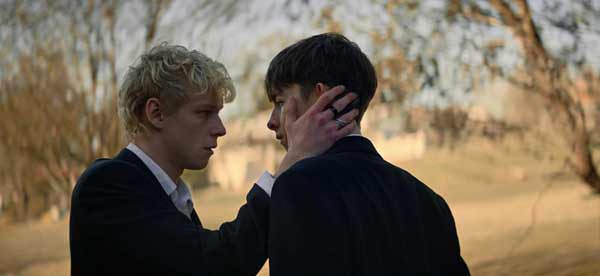
Which brings me to “Leviticus,” director Adrian Chiarella's feature debut, a queer supernatural horror film that resurrects the seemingly antiquated conventions of gay cinema’s past and makes them terrifyingly immediate again. Set in the present in a deeply religious small town in Victoria, Australia, “Leviticus” imagines a community where homosexuality isn't merely frowned upon. They've developed a grotesque ritual for eradicating it. Joe Bird and Stacy Clausen play Naim and Ryan, two outcast teens who stumble into a sexual relationship that must be kept secret at all costs. The last time we saw Bird, he was savagely bashing his head against a table in the Australian shocker “Talk to Me.” The scene was so viscerally brutal that it temporarily short-circuited my cognitive processing. Apparently Bird has decided having the holy hell beaten out of him is his niche. In “Leviticus,” he once again endures an astonishing amount of physical abuse, including someone shoving a fist into his mouth — a seeming physical impossibility until you see how horrifically plausible it looks onscreen. Following in the grim footsteps of “The Ring,” “Smile,” and “It Follows,” “Leviticus” constructs its horror around an unstoppable force. Once the evil has been unleashed — through sex in “It Follows,” through a religious conversion ritual here — it pursues its victims with mindless, pitiless determination. There is no safe place and seemingly no way to stop it. Dread settles over the movie like a lead apron, and its momentum comes largely from wondering when the next horrific attack will occur. Since the monster is born from a communal homophobia that is as natural to the town as rummage sales or the hardware store, the film's supernatural conceit proves unusually elastic. The pursuing entity becomes a metaphor for shame, religious repression, AIDS or sexual desire itself. Most powerfully, it embodies the internalized terror of being taught that the thing you most desperately want is also the thing that will destroy you. Once the horror mechanism is in place, the plot itself is relatively simple, but the love story is compelling enough that it could work even without the monster trappings. Naim and Ryan’s attraction initially expresses itself as aggression. Their first kiss comes after a shoving match that leaves both boys on the ground, suddenly face to face. Violence has brought them into physical contact before either has found the courage to ask for tenderness. What’s refreshing is that after the kiss, neither boy gets cold feet. They understand the danger they're in but refuse to let it stop them, still managing flirtatious glances during a church service and stolen meetings in an abandoned warehouse. All this sneaking around proves strangely bracing. “Leviticus” makes gay sex dangerous again. Its lovers aren't asking for acceptance; they're choosing each other in defiance of it. Which doesn't mean I want gay movies to return to closets, disapproving parents and doomed lovers. God knows we've had enough of those. But no matter how dire things become — and boy do they get dire — neither Naim nor Ryan is willing to give up the other. Mia Wasikowska is brittle and unnervingly remote as Naim’s deeply religious mother. Even when the two briefly laugh together, there's an emotional distance that keeps Naim orbiting just outside the warmth of his own family. Which is just as well. In the world of “Leviticus,” parents and siblings turn out to be less a refuge from religious fanaticism than its most intimate enforcers. The church scenes manage to make the language of love and salvation sound vaguely sinister. At one point, the congregation sings a hilariously apt contemporary Christian song about believing in something you cannot see. In another movie, that might merely be a mundane expression of faith. Here, where an invisible force is stalking two young men because of desires the community insists must not exist, the words acquire a considerably more sinister meaning.
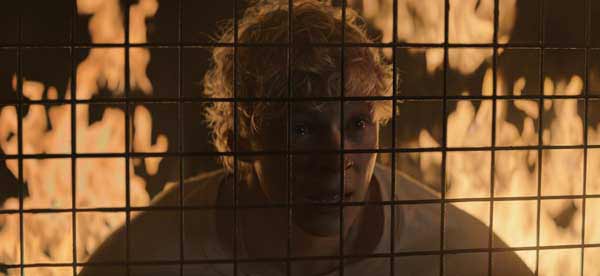
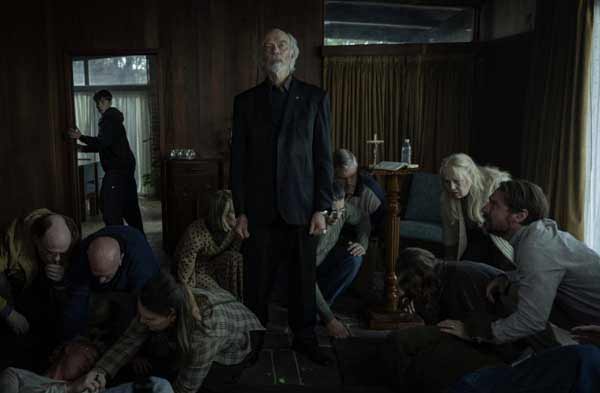
Chiarella keeps the details of the evil entity deliberately vague. Which is fine. We don't need an elaborate mythology explaining how the conversion ritual works or a rule book telling us why the monster attacks when and where it does. And yet. The screenplay is rich enough symbolically that I found myself wishing he'd explored more of the dramatic possibilities surrounding it. For instance, the film steers us toward a confrontation between Naim and Ryan and the Deliverance Healer, played with crystalline menace by Nicholas Hope, who, after performing a painful ritual of fire, incantation and projectile vomiting, has unleashed this demonic presence upon them. But instead of giving us that payoff, Chiarella pulls a bait-and-switch. And this is where “Leviticus” loses me. At least temporarily. After spending so much time making us invest in these two young men and building toward a confrontation between queer desire and the religious machinery determined to eradicate it, the movie sidesteps the reckoning altogether. Instead, we get more scenes of Naim getting his ass kicked. Again. However effectively the misdirection may work as a horror mechanism, dramatically it leaves a hole where the movie's emotional climax ought to be. The problem with this particular genre of horror — the unstoppable menace that cannot be destroyed — is how to bring things to a satisfying finish. Either the filmmakers concoct some last-minute means of defeating the undefeatable, or we get the bleak ending with its lingering aura of uncertainty. Neither solution particularly appeals to me. “Leviticus” almost makes its ambiguous ending work by focusing not on the monster or the horror, but on the love that has managed to flourish in the face of almost certain death. In a strange way, it plays like the end of “Thelma & Louise.” We don't see the car hit the desert floor, though we know what's coming. Instead, we're left with those final moments of freedom. In that sense, Chiarella finds a way out of his nightmare without pretending the nightmare is over. It's enough to make all the mayhem worth the trip. But just barely.
AVAILABLE FOR RENT ON AMAZON PRIME |

|
An LA-based playwright, JUSTIN TANNER has more than twenty produced plays to his credit, including Voice Lessons, Day Drinkers, Space Therapy, Wife Swappers, and Pot Mom, which received the PEN-West Award for Best Play. He has written for the TV shows Gilmore Girls, My So-Called Life and the short-lived Love Monkey. He wrote, directed and edited 88 episodes of the web series Ave 43, available on YouTube. Tanner is the current Playwright in Residence for the Rogue Machine Theatre in Hollywood, where his most recent play My Son the Playwright, of January of 2026, was met with rave reviews. Travis Michael Holder of the LA Drama Critics Circle wrote, "a phenomenal new achievement by local counter-culture hero Justin Tanner.”
|


To receive a free subscription to our Sunday Lounge! newsletter, Click Here
Have a suggestion? Send an email to the Editor, Click Here