





Filmmakers, Screenwriters, Performance, Reviews, Film Reviews, Streaming


All Photos Courtesy of Mubi
MINOTAUR
by Justin Tanner
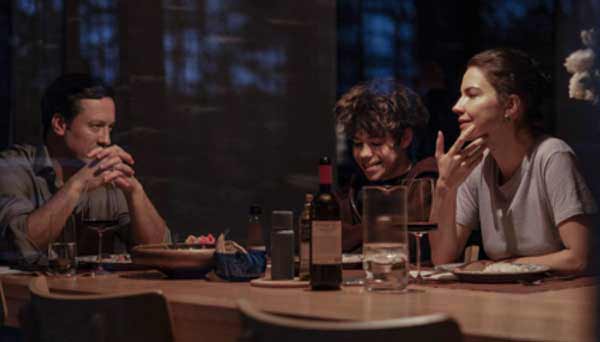
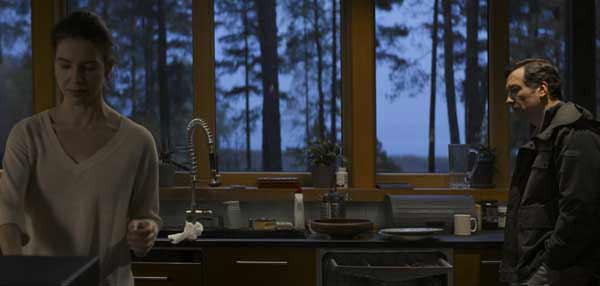
In Greek mythology, King Minos demanded that Athens send fourteen young people every nine years into a labyrinth, an elaborate maze housing the Minotaur, a monstrous creature with the head of a bull and the body of a man. There they would be devoured by the beast. Andrey Zvyagintsev's “Minotaur” relocates this ancient ritual of human sacrifice to modern Russia, where the monster has acquired a bureaucracy. It's the autumn of 2022, six months after Russia's full-scale invasion of Ukraine, and Gleb (Dmitriy Mazurov), a prosperous businessman, is ordered to supply fourteen of his employees for military service. He has one week to choose them. Otherwise, the authorities will select fourteen at random. Though the war is not the main story and rarely occupies the center of the frame, its presence is felt everywhere, like a malignant condition the country has learned to live with. Reminders appear at the margins of scenes: an office worker watching footage of buildings being bombed, the distant sounds of artillery while a couple makes love, a train passing with tanks loaded onto flatbed cars. These seemingly incidental details establish a climate of dread that both accentuates and mirrors the conflict at the heart of the film: the dissolution of a marriage. When we meet Gleb and his wife Galina (Iris Lebedeva), living with their young son Seryozha in a spectacular modernist lakefront house surrounded by forest, their marriage is already showing signs of imminent collapse. “What about the tea?” Gleb asks one night after dinner. Galina jumps up to accommodate him, but as soon as she sits back down, tea in hand, Gleb says, “I prefer coffee.” It's a small assertion of patriarchal authority that echoes throughout the film, especially when we realize that despite their considerable wealth, Galina doesn't own a car and must rely on rides from her husband or car services. She's expected to remain inside their glass-walled home, like a doll waiting to be activated, while Gleb goes out into the world to slay dragons.
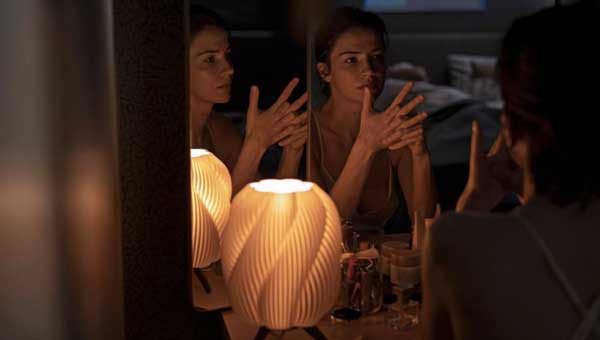
In one of the film's most revealing scenes, delivered in a single breathless take, husband and wife argue in their bedroom after a night out with friends. Galina sits at her mirror, sensually applying lotion to her legs (though we already suspect this gesture isn't for her husband), lost in a kind of reverie until Gleb enters and tries to touch her. She shies away through small, almost imperceptible movements, unwilling to allow intimacy between them. The encounter escalates into a full-blown confrontation, with Galina finally expressing her deep-seated resentment: “I'm tired of being your shadow. Gleb's wife, Seryozha's mom, the lady of the house. Where's ‘me’? Where?” “You think I owe you the answer?” “You don't. Nobody owes anyone anything.” Zvyagintsev's previous film, “Loveless,” also centers on an unhappy marriage, though in that case the toxicity is so extreme that the couple's twelve-year-old son seems to disappear off the face of the Earth. Like a combination of “Scenes from a Marriage” and “L’Avventura,” the film creates a sense of existential uncertainty and alienation that leaves the viewer shattered and empty. By contrast, the couple in “Minotaur” still retain traces of genuine affection, though these are buried beneath layers of bitterness. Galina's habit of calling or texting someone the moment Gleb leaves the room, coupled with a rather brazen lie she doesn't even bother to conceal, convinces him that his wife is having an affair. But what he intends to do about it is something even he seems unsure of. That uncertainty feeds into a series of razor-taut scenes that recall the best of Chabrol and, at times, even Hitchcock. Zvyagintsev's mastery of the tableau, his placement of figures within tightly controlled interiors, and his use of long takes that offer no respite from the emotional turmoil building within the frame give each scene a jewel-like precision. Strung together, they form a nearly perfect exercise in psychological tension, culminating in an explosion of brutal violence. Political corruption runs through much of Zvyagintsev's work, most prominently his 2014 masterpiece “Leviathan.” There, a man's home is unlawfully seized by a local mayor through an unholy alliance of state, church and judiciary, and his attempts to fight back only hasten his destruction. “Loveless,” meanwhile, depicts a police force so hobbled by bureaucracy and apathy that it can offer little help in the search for a missing child. “Minotaur” is different in that the corruption isn't simply imposed from outside. Gleb becomes an active participant, using cronyism and bribery to serve his own interests while helping to feed the Minotaur. And unlike the original myth, there is no Theseus to slay the beast. The labyrinth remains, the sacrifices continue, and survival increasingly depends on finding someone else to send inside.
Beautifully moving expressions of grief are another staple of Zvyagintsev's work, suggesting an unspoken, communal response to the betrayal of the Russian people by the Putin regime. When the young boy in “Loveless” overhears his parents saying they wish he'd never been born, his agonized sobs feel like a knife to the heart. In “Minotaur,” after Galina suffers a betrayal, she curls around her own body as though trying to protect an internal wound she cannot reach. Later, when the men from Gleb's office report for active duty, a mother collapses in the street, wailing for her son. These explosions of feeling hit all the harder because they're surrounded by scenes of extraordinary emotional restraint. The madness of the world is simply accepted until a breaking point is reached, unleashing an accumulated anguish that leaves us leveled. Zvyagintsev's willingness to expose these wounds has not endeared him to the Russian government. His work has been characterized as anti-Russian slander, exposing the nation's flaws to Western audiences. But Zvyagintsev told The Guardian that he sees himself less as an activist than as a court jester holding a mirror up to power.
Much of the joy of watching his films comes from seeing how masterfully he conveys ideas without stating them aloud. In “Minotaur,” Gleb's son Seryozha remains seemingly unscathed by his parents' volcanic rage and the country's march to war, having spent much of the film wearing headphones. Unlike the boy in “Loveless,” who is devastated by what he hears, Seryozha survives by simply not listening. This idea is gorgeously demonstrated in the film's closing shots, which recall the haunting final moments of Tarkovsky's “Solaris.” On an airplane bound for Greece, Seryozha takes a photograph of the sky outside his window, a stunning expanse of blue jeweled with blinding white clouds. He hands the phone to his parents, but the image transforms into what appear to be plumes of smoke rising from a devastated landscape. The shot lingers and lingers as Charles Ives's “The Unanswered Question” plays mournfully on the soundtrack. It's an image of extraordinary simplicity, bringing the film's domestic tragedy and political nightmare together without a word of explanation. IN THEATERS |
|
An LA-based playwright, JUSTIN TANNER has more than twenty produced plays to his credit, including Voice Lessons, Day Drinkers, Space Therapy, Wife Swappers, and Pot Mom, which received the PEN-West Award for Best Play. He has written for the TV shows Gilmore Girls, My So-Called Life and the short-lived Love Monkey. He wrote, directed and edited 88 episodes of the web series Ave 43, available on YouTube. Tanner is the current Playwright in Residence for the Rogue Machine Theatre in Hollywood, where his most recent play My Son the Playwright, of January of 2026, was met with rave reviews. Travis Michael Holder of the LA Drama Critics Circle wrote, "a phenomenal new achievement by local counter-culture hero Justin Tanner.”
|


To receive a free subscription to our Sunday Lounge! newsletter, Click Here
Have a suggestion? Send an email to the Editor, Click Here