





Filmmakers, Screenwriters, Performance, Reviews, Film Reviews, Streaming

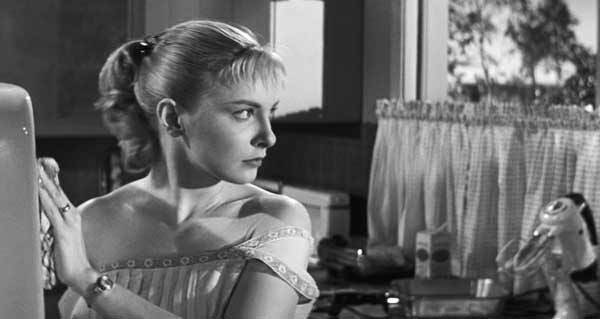
All Photos Courtesy of 20th Century Fox
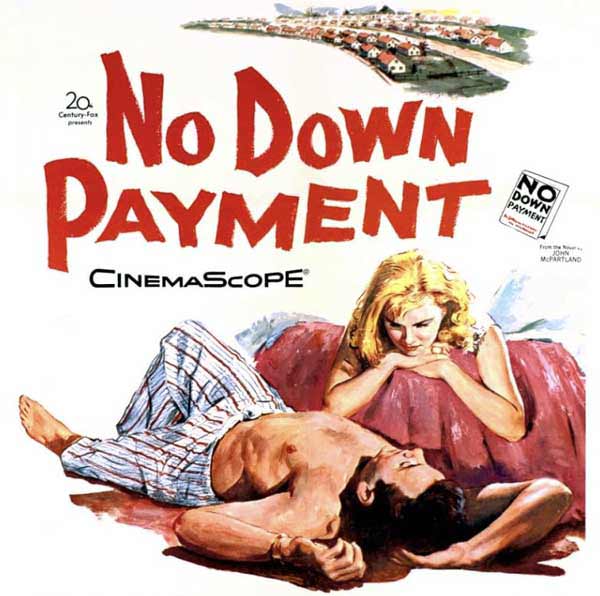
NO DOWN PAYMENT
by Justin Tanner
For the month of July, the Criterion Channel is running a collection called "Murderous Melodramas," featuring films like "Leave Her to Heaven," "Desert Fury," "Violent Saturday," "A Kiss Before Dying," "Bigger Than Life," "Written on the Wind," and "Some Came Running." They're glorious relics from the late '40s and '50s, drenched in Technicolor, populated by actors behaving as though every disappointment were a five-alarm fire, and propelled by tawdry plots that inevitably end in violence. Alcoholism is one of the recurring afflictions in these films, giving their casts ample opportunity to indulge in some of cinema's greatest, and at times broadest, bouts of drunk acting. In “Written on the Wind,” Robert Stack and Dorothy Malone play a brother and sister whose slurred, staggering inebriation is so extravagantly pitched it circles back from tragedy into something approaching slapstick. Meanwhile, Frank Sinatra and Dean Martin, perhaps from experience, bring a startling naturalism to their alcoholic binges in “Some Came Running.”
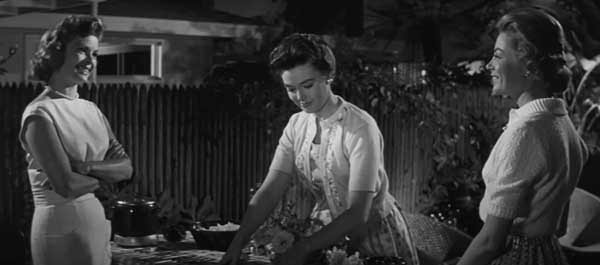
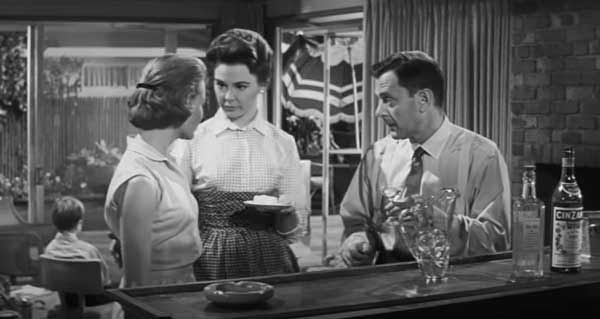
Best of all, though, is Tony Randall in “No Down Payment,” a film I'd somehow never seen. As Jerry Flagg, a used-car salesman struggling to support his family on a shrinking income, Randall uncovers depths of grandiosity, self-loathing, and simmering resentment I'd never have thought possible from an actor I'd previously associated almost exclusively with light comedy. After drunkenly groping a new neighbor at a backyard barbecue and getting gently scolded by his long-suffering wife (a heartbreaking Sheree North), Jerry replies with a disarming smile, "I like to drink. It does things for me. It makes me feel like I'm somebody." The simplicity of the line catches you off guard. Like so many moments in this remarkable film, it brings us uncomfortably close to emotions that are usually hidden beneath melodrama.
Though “No Down Payment” eventually reaches the expected fever pitch of violence and emotional excess, there's a startling honesty to the dialogue and performances that allows it to transcend its era. Nearly seventy years later, it still feels surprisingly modern. Set in a newly built Southern California subdivision born of the G.I. Bill housing boom, the film follows four neighboring couples whose lives are lived in almost full view of one another. The newlywed Martins (Jeffrey Hunter and Patricia Owens), for instance, can see directly into the bedroom of their neighbors, the Boones (Cameron Mitchell and Joanne Woodward). The opening theme, with its buoyant Doris Day cheerfulness, promises one kind of movie. What follows is something darker: a claustrophobic portrait of ordinary lives coming apart. The male-female power dynamic inevitably feels dated. Divorce carried enormous stigma, economic independence was less attainable for women, and the film often treats entrapment as simply another fact of married life. It's easy to watch from a contemporary perspective and wonder why some of the wives don't just walk away. Yet the emotional conflicts remain surprisingly timeless. Abortion, sexual promiscuity and domestic abuse aren't merely hinted at; they're woven directly into the stories, often with stunning frankness.
Most surprising of all is how painfully relevant the film's treatment of racism still feels. Herman and Betty Kreitzer (Pat Hingle and Barbara Rush), easily the warmest and most decent couple of the group, face an impossible situation when Herman, who owns a local appliance store, is forced to tell his best employee, a Japanese American man, that he can't move into the neighborhood because it's restricted to whites. At first, the casual acceptance of segregation feels like something safely confined to another era. Then you remember how often the 1950s are invoked as a simpler, better time. "No Down Payment" serves as a sobering reminder that the simplicity so many people romanticize depended, in part, on exactly these kinds of exclusions.
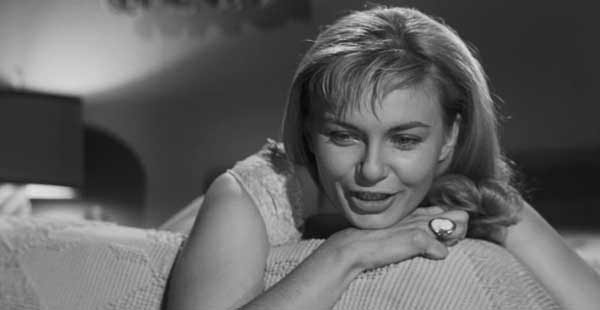
Director Martin Ritt, in only his second feature, draws wonderfully natural performances from the entire cast, most notably the radiant Joanne Woodward, whose goofy warmth provides a welcome counterweight to the film's increasingly grim emotional terrain. And when the violence finally erupts, as it inevitably must, it's Woodward's horrified reaction that lands the emotional blow. On one level, "No Down Payment" works simply as a melodrama of suburban disillusionment. It isn't hard to see why David Jacobs cited it as an inspiration for "Knots Landing," which would spend fourteen seasons exploring similar emotional terrain. But beneath the soap-opera plotting is something much rarer: a willingness to let ordinary people voice thoughts polite society usually teaches us to suppress. The dialogue repeatedly wanders into morally uncomfortable territory without flinching. When one husband asks his wife, "How can you call yourself a good Christian and speak like that?" it doesn't feel like a screenwriter making a point. It feels like two people exposing something raw about themselves. That's what gives the film its lasting power. It isn't merely interested in dramatic situations. It's interested in the uncomfortable truths those situations force people to reveal. STREAMING ON CRITERION CHANNEL |
|
An LA-based playwright, JUSTIN TANNER has more than twenty produced plays to his credit, including Voice Lessons, Day Drinkers, Space Therapy, Wife Swappers, and Pot Mom, which received the PEN-West Award for Best Play. He has written for the TV shows Gilmore Girls, My So-Called Life and the short-lived Love Monkey. He wrote, directed and edited 88 episodes of the web series Ave 43, available on YouTube. Tanner is the current Playwright in Residence for the Rogue Machine Theatre in Hollywood, where his most recent play My Son the Playwright, of January of 2026, was met with rave reviews. Travis Michael Holder of the LA Drama Critics Circle wrote, "a phenomenal new achievement by local counter-culture hero Justin Tanner.”
|


To receive a free subscription to our Sunday Lounge! newsletter, Click Here
Have a suggestion? Send an email to the Editor, Click Here