





Filmmakers, Screenwriters, Performance, Reviews, Film Reviews, Streaming

All Photos Courtesy of Greenwich Entertainment
OMAHA
by Justin Tanner
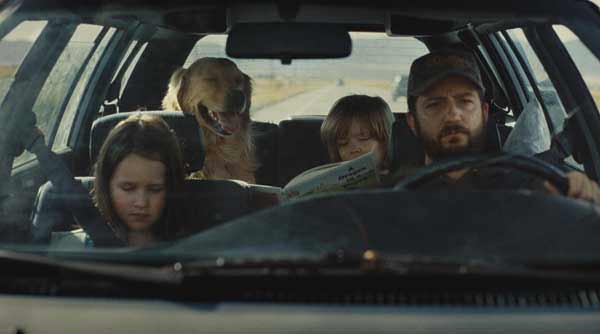
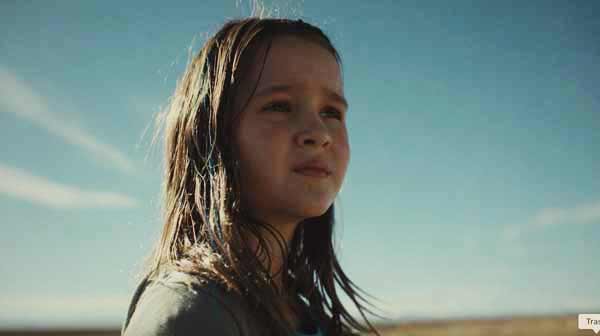
Child actors are a dicey prospect under the best of circumstances. Precocity has its place, of course, but very young performers can easily be pushed too far by directors who mistake cute for charming or volume for exuberance. The best child performances share the unusual quality of remaining distinctly childlike while somehow conveying emotional complexities they shouldn't have the life experience to understand. In "Omaha," Cole Webley's feature debut about a family road trip, Molly Belle Wright plays Ella, a nine-year-old girl who's inherited the responsibilities her recently deceased mother left behind. From her first appearance, she seems to be bracing for disaster. When her dad (a beautifully controlled John Magaro) wakes her before dawn and says, "We gotta go. Pretend there's a fire in the house," Ella responds with the wary alertness of a child who's been through this before. She obeys her dad, but she never stops watching him. Only twice does her composure give way. When it does, and Ella is reduced to a terrified child begging for the world to make sense again, the release is overwhelming because Wright has held so much in reserve. It's an astonishing piece of film acting from someone so young. Wyatt Solis, as Ella's younger brother Charlie, has the goofy, kinetic dynamism of a six-year-old Jim Carrey. Whether he's singing along to Tommy James' "Mony Mony" while dancing in the backseat of a car, or accosting his horrified sister with increasingly revolting rounds of "Would you rather...?", Solis takes Charlie right to the edge of annoying without ever crossing the line. His comic timing feels completely unforced, as though the camera happened to catch a real child just being himself.
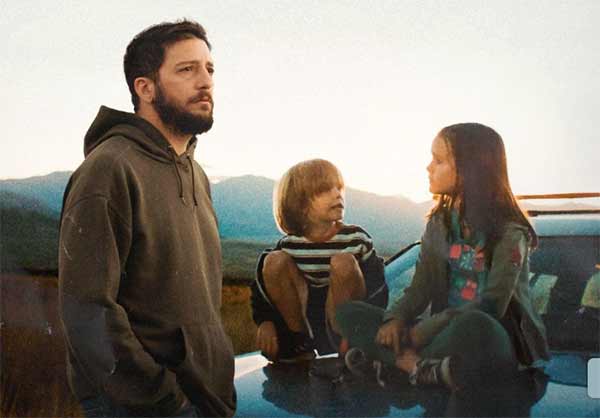
The thought of spending a cross-country road trip trapped in a car with two young children sounds like my definition of hell. But Belle Wright and Solis are such engaging company I quickly forgot the premise should be exhausting. Magaro has the film's most difficult assignment. He has to play a character whose behavior only fully makes sense in retrospect. Every scene carries two meanings: one for the audience experiencing it for the first time, another for viewers who understand where the story is heading. Magaro threads that needle with remarkable precision. Meanwhile, Director Webley keeps us in the dark for as long as possible, filtering the story almost entirely through the children's perspective. In one scene, Magaro speaks with a county sheriff. But just as he seems about to say something relevant, the camera cuts back to the children watching from inside the car, forcing us to piece together the truth and trust the destination will justify the journey. Everything unfolds like a family vacation, except no one seems entirely convinced they're on one. There are fast-food meals, radio singalongs, truck-stop bathrooms, tacky motels, and the creeping fatigue that settles over people who've spent too many hours together in a car. No one ever asks, "Are we there yet?" but nearly every other road-trip cliché finds its place. There is clearly a vast ocean of love between the father and his children. He's patient, gentle, and rarely raises his voice. Yet grief has so distorted his judgment that he no longer recognizes the boundary between childhood and adulthood. When the family's aging car refuses to start, he asks nine-year-old Ella to climb out and push while he pop-starts the engine. Watching this little girl throw all her weight behind a three thousand pound vehicle without hesitation tells us all we need to know about the skewed dynamics at work. At first glance, there's not much plot to "Omaha." After their home is foreclosed on, a father and his two children grab what they can and hit the road, drifting from one motel, gas station, and fast-food joint to the next before eventually arriving at their destination.
Even the film's lean 83-minute running time can occasionally feel stretched by lingering shots of empty landscapes and Charlie sleeping beside the family dog. But Webley is playing a long game. By the end, what initially seemed like narrative drift has revealed itself as meticulous misdirection. A passing glimpse of a "McCain 2008" campaign sign seemingly explains the absence of cell phones before circling back to haunt the film's unspoken reality in a closing postscript that adds the final clue to the puzzle. I wasn't expecting to be so moved by a few words of onscreen text, but Webley casts everything we've seen in a heartbreaking new light with a poetic simplicity. Every road trip exists between two fixed points. What happens between them is often the story of a family becoming itself. In our house, that meant screaming matches by hour three and spankings before dinnertime. But the family in “Omaha” is taking a different kind of trip. Tested boundaries are met with patience rather than punishment. There is no inevitable explosion waiting around the next bend. The tension doesn’t come from conflict but from an unspoken something impossible to name. Until the journey has ended and we realize that every mile they've traveled together has been precious. AVAILABLE TO RENT ON AMAZON PRIME |
|
An LA-based playwright, JUSTIN TANNER has more than twenty produced plays to his credit, including Voice Lessons, Day Drinkers, Space Therapy, Wife Swappers, and Pot Mom, which received the PEN-West Award for Best Play. He has written for the TV shows Gilmore Girls, My So-Called Life and the short-lived Love Monkey. He wrote, directed and edited 88 episodes of the web series Ave 43, available on YouTube. Tanner is the current Playwright in Residence for the Rogue Machine Theatre in Hollywood, where his most recent play My Son the Playwright, of January of 2026, was met with rave reviews. Travis Michael Holder of the LA Drama Critics Circle wrote, "a phenomenal new achievement by local counter-culture hero Justin Tanner.”
|


To receive a free subscription to our Sunday Lounge! newsletter, Click Here
Have a suggestion? Send an email to the Editor, Click Here