





Filmmakers, Screenwriters, Performance, Reviews, Film Reviews, Streaming

All Photos Courtesy of Warner Brothers Pictures
THE END OF OAK STREET
by Justin Tanner
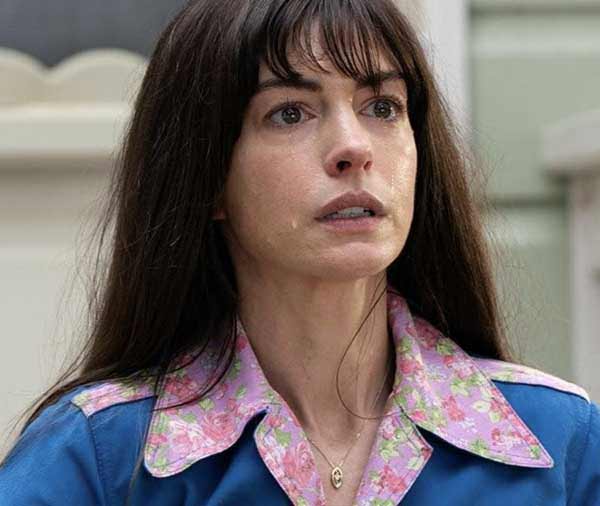
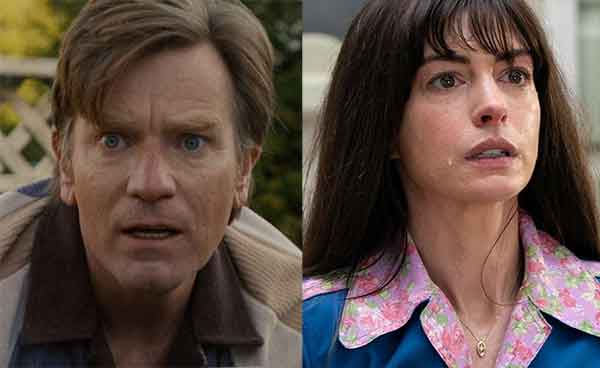
We need to talk about Anne. Hathaway fatigue is real. No offense — she’s been perfectly fine in the past — but lately we’ve been oversaturated with product. So far this year we’ve had “Mother Mary,” “The Devil Wears Prada 2,” “The Odyssey” and now “The End of Oak Street,” with “Verity” still to come in October. For fans, this must seem heaven-sent. But I’ve always been on the fence about her. There’s an over-earnestness to Hathaway that can curdle into kitsch. She tends to hit comedy just a little too hard, so you notice her working instead of the work. And in dramatic roles, she can linger on the verge of weepiness long after the moment has stopped paying dividends. In “Mother Mary,” she was never quite convincing as an artsy pop star in the Lana Del Rey mold and spent way too much time in the tear-swallowing cul-de-sac of her worst tendencies. In “The Devil Wears Prada 2” she seemed to be on autopilot, staring vaguely into space for two hours while waiting for direction. And in “The Odyssey,” her anxious grief read as nobility before you realized it was the only color she intended to use. In “The End of Oak Street,” Hathaway is once again in drama mode, albeit in a considerably less morose key than “The Odyssey.” But for a piece of summer dinosaur fluff, she once again seems to have miscalculated the needs of the material. All the role calls for is a little raw fear and quiet strength. Instead, we get Hecuba in the “Trojan Women.” Not helping matters is the usually reliable Ewan McGregor as Hathaway’s unemployed, secretly alcoholic husband. His shaky American accent gives the dialogue the uncanny quality of a bad dub, while his performance lurches from emphatic to phoned-in without ever finding its footing. Still, even with its two stars not in their best form, the darn thing somehow works. It’s not a great movie, but it’s brisk and occasionally smart. And in a summer of lumbering juggernauts, that’s quite an accomplishment. It’s a bit of a departure for director David Robert Mitchell, whose two previous movies, “It Follows” and “Under the Silver Lake,” both told rather grim stories through a distinctly cynical lens.
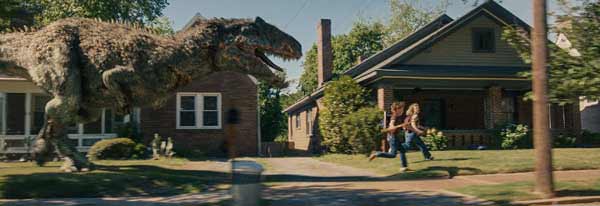
“The End of Oak Street,” on the other hand, frames its apocalyptic dinosaur epic within the rosy, somewhat fraught arc of a Lifetime family drama. Which is perhaps why it’s being compared to the early work of Spielberg, though that might have more to do with the Amblin-esque soundtrack and suburban setting than the film’s actual tone. Spielberg has never been afraid to sacrifice credibility for a laugh. He loves a good dad joke, especially when paired with a generous helping of sentimentality. And at first blush, Mitchell seems to be preparing us for exactly that kind of movie. The film, set in the early ’80s, opens at a neighborhood block party, with Pat Benatar on the soundtrack and dozens of happy families mingling in the street, evoking the kind of Norman Rockwell suburbia popularized by Spielberg, Howard and Reiner. And yet, the first fifteen minutes are almost aggressively generic, with a marked lack of specificity to the dialogue. The blandness is a little off-putting at first, but still preferable to the self-conscious yuks we usually get in these kinds of films. Without lame attempts at humor sideswiping us every three minutes, we’re allowed to remain inside the world of the movie rather than constantly being reminded that somewhere, a roomful of screenwriters has been hard at work manufacturing “fun.” Still, once the titular Oak Street gets transported seventy-five million years into the past and our characters start getting chomped by rampaging raptors, the movie achieves liftoff in a big way. It’s been a long time — and way too many terrible sequels — since “Jurassic Park” first thrilled us with its groundbreaking CGI effects. By now, we’ve become blasé about onscreen dinosaurs. There are only so many ways to stage a chase or show somebody getting their head bitten off. But with “The End of Oak Street,” the action sequences feel fresh and exciting again. Part of it is the prevalence of daylight. Most of the mayhem unfolds in full sun, where every bone-crunching chomp retains its visceral immediacy simply because we can actually see it. And Mitchell has a lot of fun teasing us, showing just the back fin of a dinosaur above the tree line, or a slithering tail curling around the side of a house, before finally dropping one directly into our laps. The buildup and release feel organic, never manipulative. Where Spielberg likes to tee up his set pieces until the anticipation threatens to wear us out before we even get to the climax, Mitchell keeps us off balance, never hinting about what’s going to happen, or when. Any character could get eaten at any moment, and that unpredictability keeps us on edge until the very end. There are also scenes of genuine humor mixed with a strange elegance, as when the family tries to navigate a car through a herd of giant turtles, or a seemingly endless snake slithers unnoticed through the front door and up three flights of stairs. Even within the strictures of a big-budget Warner Bros. tentpole, Mitchell’s most inspired moments come from following his own singular imagination. As for the acting, the kids are the real find. Both Maisy Stella as Audrey and Christian Convery as Brian modulate their performances with great delicacy, moving from concern to panic to outright terror with heart-pounding immediacy. And even though Hathaway and McGregor fumble the ball repeatedly, they end up sharing one of the film’s best moments. During a brief respite from all the running and screaming, they come across something that stops them dead in their tracks. Then, unexpectedly, they start to laugh. Delight pushes terror to the margins as Hathaway whips out a Polaroid camera to capture a circa-1980 selfie, by way of the Late Cretaceous. Best of all is a sequence around the halfway point that’s startling in its thematic audacity, especially for a film being marketed as family entertainment. With things looking particularly grim, and the family finally confronting the possibility that they may not survive, they have a bracing discussion about God, of all things. Not the Christian God — Jesus is never mentioned — but belief itself, and what that belief might mean when the world has become inexplicable. For a few minutes, the movie seems to exist entirely in the here and now, inviting us into the conversation and asking us to plug in our own moment of uncertainty. What exactly do we believe in? Is the chaos and misery of an unexplainable world helped or hurt by the possibility of a God somewhere on the periphery, watching with or without interest? I couldn’t believe the film had the nerve to ask its audience to sit with a question like that, even if only for three minutes.
I saw “The End of Oak Street” while on vacation, when it was 100 degrees outside. The theater was air-conditioned, the seats were comfy and, though the audience was chattier than I usually like, there was a nice sense of community as we all seemed to understand that this is what summer movies are for: 90 minutes in a cool, dark room, watching people fight for their lives — and survive — against an overpowering menace. Popcorn was eaten, sodas were drunk, and the actual world faded away just long enough to recharge the batteries for another day. Hollywood got out of its own way long enough to do something it seems less and less inclined to do. Entertain. IN THEATERS |
|
An LA-based playwright, JUSTIN TANNER has more than twenty produced plays to his credit, including Voice Lessons, Day Drinkers, Space Therapy, Wife Swappers, and Pot Mom, which received the PEN-West Award for Best Play. He has written for the TV shows Gilmore Girls, My So-Called Life and the short-lived Love Monkey. He wrote, directed and edited 88 episodes of the web series Ave 43, available on YouTube. Tanner is the current Playwright in Residence for the Rogue Machine Theatre in Hollywood, where his most recent play My Son the Playwright, of January of 2026, was met with rave reviews. Travis Michael Holder of the LA Drama Critics Circle wrote, "a phenomenal new achievement by local counter-culture hero Justin Tanner.”
|


To receive a free subscription to our Sunday Lounge! newsletter, Click Here
Have a suggestion? Send an email to the Editor, Click Here