





Filmmakers, Screenwriters, Performance, Reviews, Film Reviews, Streaming

All Photos Courtesy of Universal Pictures
THE ODYSSEY
by Justin Tanner
Long before audiences had a chance to argue about Christopher Nolan's "The Odyssey" as a movie, they were arguing about it as a political Rorschach test. The casting of black actors Lupita Nyong'o and Travis Scott, and trans actor Elliot Page, ignited months of online outrage, much of it driven by right-wing commentators who framed the film as another example of Hollywood's supposed surrender to "wokeness." Among the most strident critics was Awards Daily founder Sasha Stone, who lamented that Hollywood had reached "Peak Woke" and predicted that the casting would "turn what should just be a movie for everyone into a political battleground." What followed was a familiar ritual of online outrage. Everyone, it seemed, had an opinion about a film no one had actually seen.
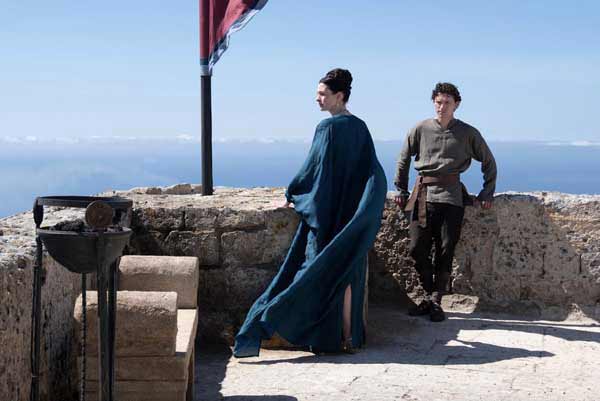
Now that “The Odyssey” has opened to rave reviews and enormous box office, many of the loudest voices have begun revising their original narratives. Stone now argues she never believed the film was "woke," instead claiming that the left deliberately leaked the casting information to bait conservatives into outrage. According to Stone, the right "had no idea they were being played." Somewhere beneath all of that is an actual movie. That's the one I'd like to talk about. But the tribal nature of contemporary discourse creates an odd problem for a critic. I didn't care much for "The Odyssey," largely because of its casting — but not the casting choices that fueled weeks of controversy. Unfortunately, mention Nolan's film and the word casting in the same sentence, and many people assume they already know what you're about to say. So let me be clear: Trans actor Elliot Page is very good as the Greek warrior Sinon, sporting a physique robust enough to send the online casting police back to their keyboards. Plus, his confrontation with Odysseus in Hades is one of the film's acting highlights. Nyong'o, by contrast, has less than a minute of screen time. She's perfectly fine as Helen of Troy (and slightly less convincing as Helen's twin sister, Clytemnestra), but the role is over almost before it begins. As for rapper Travis Scott as the poet Demodocus, it's difficult to judge the performance because every line of his dialogue is punctuated by him slamming an enormous staff into the ground. The effect is so startling that I jumped nearly every time it happened — and it happened a lot. But no, it's the other casting choices — the major ones — that throw the film off balance. Nolan has assembled an astonishing roster of A-list actors for nearly every significant role. Not since the all-star disaster movies of the 1970s has so much celebrity been gathered in one place. Yet, talented though they all are, most have been cast against their strengths, to the detriment of the film. Nolan is already the biggest star attached to a Christopher Nolan movie. He didn't need this much celebrity. Too often, we're reminded that we're watching movie stars instead of Greeks. Matt Damon lost thirty pounds and grew out his beard for a year in order to play Odysseus. But even beneath all that leather and bronze, Damon never seems like anyone but Matt Damon. He simply can't escape his own persona. The thinly written screenplay doesn't help. Perhaps if Nolan had given Damon richer dialogue, we wouldn't be forced to rely so heavily on the actor to tell us who Odysseus is. When Kirk Douglas played the role in 1954's "Ulysses," his persona matched the character perfectly. That's what good casting is. The better the fit, the less work the actor has to do. But Damon can't pull off that trick. Even in his best moments, all we see is the effort.
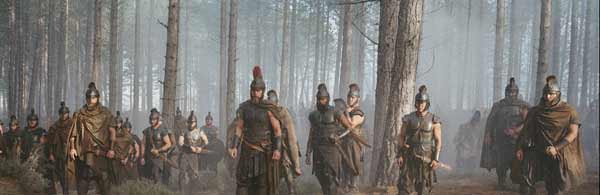
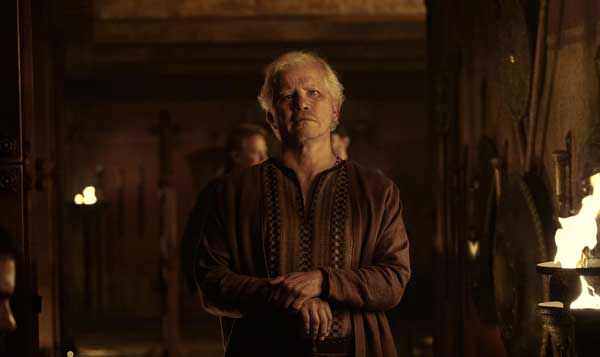
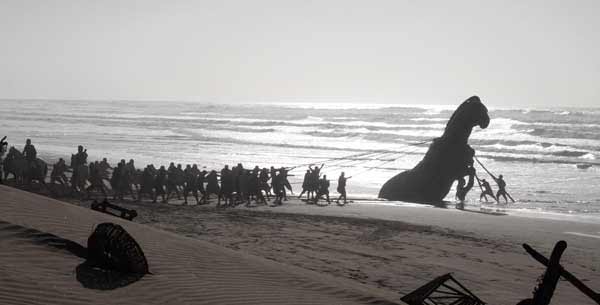
Anne Hathaway presents a different problem. She brings honesty and gravity to Penelope, but the role demands more than sorrow. Penelope isn't merely a grieving wife; she's also a queen whose intelligence keeps her kingdom — and her suitors — at bay for twenty years. Hathaway conveys the heartbreak, but not the innate regality or cunning the role requires. Rebecca Ferguson or Emily Blunt might have supplied that missing dimension. Robert Pattinson plays Antinous as a straightforward jerk, leaving little room for charm or complexity. A good villain has sides. Alan Rickman in “Die HArd,” and Christoph Waltz in “Inglourious Basterds” are terrifying because they're also charming. Even the slightest glimmer of that quality from Pattinson would have made Antinous a far more memorable villain. The real trouble comes from Charlize Theron's Calypso, played like a perfume commercial come to life; Zendaya's Athena, another enigmatic whisperer who seems to have wandered over from the set of "Dune: Part Three"; and, most egregiously, John Leguizamo as Eumaeus the loyal swineherd, whose silent-film mugging drew an unintended laugh from me more than once. The overall problem is that, while there's an awful lot of acting going on, almost nobody seems to be giving an actual performance. Nobody, that is, except Samantha Morton, whose brief appearance as Circe is undoubtedly the highlight of the film. As she's done so many times before — most recently as Harvey Weinstein's assistant, Zelda Perkins, in the otherwise moribund "She Said" — Morton walks onscreen and hijacks the movie through the sheer force of her imagination. In the film, Circe lures violent men into her lonely cabin before transforming them into animal versions of their inner selves. The practical effects are extraordinary here, as Morton rubs, throttles, and forces her hands beneath the facial skin of Odysseus' crew, body-horroring them into pigs. In barely ten minutes of screen time, she brings charm, sadism, regret, and poignance to the role. It's a tour de force from which the movie never quite recovers. Of course, being a Nolan film, the visual effects are top-tier. Every warship, castle, battle, and suit of armor is rendered with his customary eye for detail. And yet, thinking back, only one image lingers: the first shot of the Trojan Horse, washed ashore and half-submerged in the sea. Slightly reminiscent of the Statue of Liberty in "Planet of the Apes," it's instantly iconic.
Nolan's attempt to fracture the narrative into nonlinear episodes is far less successful. It's the sort of storytelling trick Quentin Tarantino can pull off in his sleep, but here each episode feels self-contained, depriving the film of any cumulative momentum. Rearrange most of the adventures, and very little would change. Luckily, during the last twenty minutes, Nolan pulls everything together. Like "Top Gun: Maverick," another overlong blockbuster that sticks the landing, "The Odyssey" is rescued by its final reel. When Odysseus returns to Ithaca to confront the suitors who've occupied his home for twenty years, he locks them in a room and, bow in hand, essentially recreates the climax of "We Need to Talk About Kevin." For twenty exhilarating minutes, the film acquires the momentum and urgency that have been missing all along. While watching “The Odyssey,” I kept wondering, "Why this story, and why now?" Nolan eventually answers that question, and rather beautifully. He treats it almost like a plot twist. Disguised as a beggar, Odysseus tells Penelope a tragic story about the sacking of Troy that casts everything we've seen in a new light. It's a surprisingly moving moment, recalling the scene in "Oppenheimer" when the unseen horrors of Hiroshima suddenly transform pages of equations and scientific abstractions into the reality of unimaginable human suffering. It's also the moment when Matt Damon comes closest to disappearing into the role. I was so absorbed that I forgot how long I'd been sitting in the theater and simply surrendered to cinema's ability to wring catharsis from the most unexpected places. I can't call "The Odyssey" a great film, though greatness occasionally flickers within it. For all its missteps, Nolan ultimately finds the emotional truth he was searching for: the moving image's unique ability to unburden the weary spirit. IN THEATERS |
|
An LA-based playwright, JUSTIN TANNER has more than twenty produced plays to his credit, including Voice Lessons, Day Drinkers, Space Therapy, Wife Swappers, and Pot Mom, which received the PEN-West Award for Best Play. He has written for the TV shows Gilmore Girls, My So-Called Life and the short-lived Love Monkey. He wrote, directed and edited 88 episodes of the web series Ave 43, available on YouTube. Tanner is the current Playwright in Residence for the Rogue Machine Theatre in Hollywood, where his most recent play My Son the Playwright, of January of 2026, was met with rave reviews. Travis Michael Holder of the LA Drama Critics Circle wrote, "a phenomenal new achievement by local counter-culture hero Justin Tanner.”
|


To receive a free subscription to our Sunday Lounge! newsletter, Click Here
Have a suggestion? Send an email to the Editor, Click Here