





Filmmakers, Screenwriters, Performance, Reviews, Film Reviews, Streaming

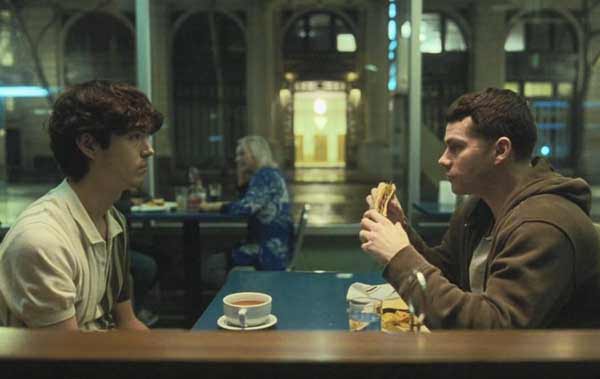
All Photos Courtesy of Roadside Attractions
TWINLESS
by Justin Tanner
I read a lot of praise for James Sweeney's sophomore film, "Twinless," when it came out last September, but because I was on hiatus from reviewing movies, I missed seeing it in theaters. One of the occupational hazards of being a critic is that, after spending years analyzing plots, performances, editing, and directing, it becomes difficult to watch a film without instinctively beginning an autopsy. So I simply stopped going to the movies. I wrote a play instead. I binged TV shows. And, in the process, I missed two years' worth of great cinema. Fortunately, streaming has made it easy to fill in the gaps. I watched “Twinless” last week and I’m still thinking about it. I'd seen Sweeney's first film, "Straight Up," back in 2019 and liked it well enough, but I didn't come away thinking he was a director to follow. In it, Sweeney plays a conflicted gay man who experiments with heterosexuality. He and co-star Katie Findlay have terrific chemistry, their rapid-fire dialogue recalling the screwball rhythms of Howard Hawks. But the surrounding cast's obvious inexperience undercuts the film, and the visual style often feels equally tentative, relying on static two-shots that never quite match the screenplay's sophistication. With "Twinless," Sweeney has taken a giant step forward. His cinematic imagination has caught up with his crackling wit, allowing him to move effortlessly from romantic comedy to psychological drama, from mystery to tragedy, without ever losing his balance. It starts with the sound of an offscreen hit-and-run, followed by a quick cut to a funeral. Roman (Dylan O'Brien) and his mother (Lauren Graham), stand beside a coffin as a procession of mourners files past to offer their condolences. But no one can look at Roman without becoming overwhelmed. "I'm sorry, it's like looking at a ghost," one mourner says before bursting into tears. Another gasps, "Oh God, your face," then staggers away.
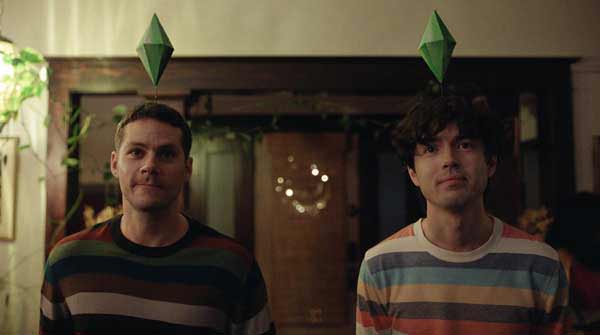
Roman had an identical twin, and it quickly becomes clear that, even in death, his brother's presence continues to eclipse him. Seeking comfort, Roman attends a bereavement group for twins, where he meets Dennis (writer/director Sweeney). They bond over the terrible cookies being served. "I wouldn't eat that. Tastes like balls," Roman says. "Mmm, I like balls," Dennis replies before taking a bite, chewing thoughtfully for a moment, then immediately spitting it into a trash can. The exchange opens the door to a conversation about grief and sexuality. Roman reveals that his brother was gay; Dennis says his was straight. Almost instantly, the two recognize something familiar in each other: someone who instinctively understands the shape of the other's grief. Their shared sense of loss forges an immediate friendship that deepens into an unexpectedly tender bromance. It's here, twenty minutes into the film, that the opening credits finally roll and Sweeney rewinds the narrative from Dennis' point of view. Much like Zach Cregger's "Weapons," the shifting perspective doesn't rewrite events so much as deepen our understanding, revealing how thoroughly we've misread what we've seen. It's a bold structural gamble, one that transforms what initially seemed like a straightforward comedy into something stranger, sadder, and considerably more suspenseful. Nor does Sweeney's inventiveness stop there. When Dennis invites Roman to his coworker Marcie's birthday party and each pursues a different romantic interest, the screen splits in two, allowing both stories to unfold simultaneously. But it's more than a clever visual flourish. Sweeney uses the split screen to create almost unbearable tension. Dennis has begun to develop feelings for Roman, but while he's distracted by a handsome stranger at the party, Roman and Marcie begin to fall for each other. Dennis doesn't realize what's happening, but we do. When he finally goes looking for Roman, we experience his heartbreaking discovery from both perspectives at once. It's an inspired use of the technique, transforming what could have been a simple romantic misunderstanding into one of the film's most emotionally devastating sequences.
The introduction of Marcie (Aisling Franciosi, endearing and exasperating in equal measure) turns the bromance into a love triangle, and dramatically raises the stakes. Dennis, who initially seemed like little more than a snarky goofball with a heart, gradually reveals a possessive streak that's as manipulative as it is unhinged. With little regard for appearances, he wedges himself into the growing romance between Roman and Marcie until the situation reaches an unexpected breaking point. What Sweeney understands exceptionally well is the complicated emotional terrain between gay and straight men, and the different desires that can coexist within the same friendship. For Roman, Dennis represents a chance to reconnect with the brother he's lost. In one blistering scene, he speaks to Dennis as though he were Rocky himself, culminating in a devastating emotional collapse. For Dennis, the relationship offers something altogether different: the intoxicating possibility of stepping across a line he knows he shouldn't cross. Each believes he's found exactly what he's been missing. The tragedy is that they're searching for two entirely different things. The performances are nuanced and full of surprises. Sweeney is hilariously dry when on the attack and deeply vulnerable when finally cornered. O'Brien plays Roman as charmingly guileless, stopping just short of caricature. But the real revelation is Sweeney's direction. The instincts that felt tentative in "Straight Up" have matured into complete confidence. Every camera placement, movement, and edit serves a purpose. A simple moment in which Roman glances over his shoulder while walking down the street echoes an earlier scene, transforming a casual gesture into something that feels like memory itself. It's exhilarating to watch a filmmaker's technique finally catch up with his imagination. STREAMING ON HULU |

|
An LA-based playwright, JUSTIN TANNER has more than twenty produced plays to his credit, including Voice Lessons, Day Drinkers, Space Therapy, Wife Swappers, and Pot Mom, which received the PEN-West Award for Best Play. He has written for the TV shows Gilmore Girls, My So-Called Life and the short-lived Love Monkey. He wrote, directed and edited 88 episodes of the web series Ave 43, available on YouTube. Tanner is the current Playwright in Residence for the Rogue Machine Theatre in Hollywood, where his most recent play My Son the Playwright, of January of 2026, was met with rave reviews. Travis Michael Holder of the LA Drama Critics Circle wrote, "a phenomenal new achievement by local counter-culture hero Justin Tanner.”
|


To receive a free subscription to our Sunday Lounge! newsletter, Click Here
Have a suggestion? Send an email to the Editor, Click Here