





Filmmakers, Screenwriters, Performance, Reviews, Film Reviews, Streaming

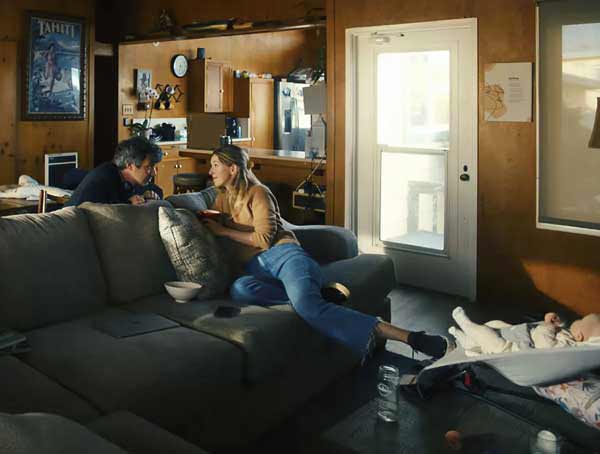
All Photos Courtesy of A24
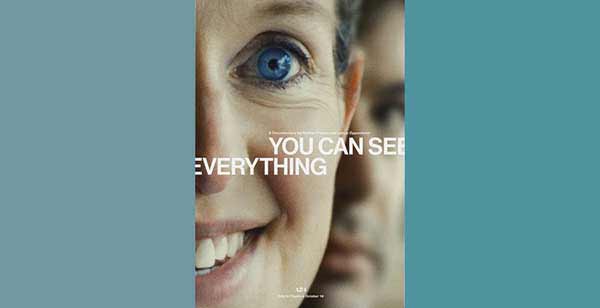
YOU CAN SEE EVERYTHING
by Justin Tanner
One of the best movie reviews I ever read was only four sentences long. Back in 1985, Michael Ventura wrote this about Woody Allen's “The Purple Rose of Cairo” in the LA Weekly:
I did exactly as he suggested, and when the film's marvelous reveal played out onscreen, I let out the kind of involuntary gasp of delight that only genuine surprise can evoke. And I've been silently thanking Ventura ever since. I'd had movies spoiled for me before. While standing in line for “The Empire Strikes Back,” a passing motorist shouted the film's biggest secret about Luke Skywalker's parentage and the hundred or so people waiting in line were so devastated that if we'd managed to catch the jerk, we'd have torn him limb from limb. “You Can See Everything” doesn't hinge on a revelation of that magnitude. Its surprises are more intimate, sometimes turning on a single word or a meaningful glance. But their accumulation makes for one of the most compelling moviegoing experiences I've had this year. So I'm going to follow Ventura's example: If you haven't seen “You Can See Everything,” stop reading, find the next available screening and just go. From here on out, it's spoiler city. Nathan Fielder and Lance Oppenheim have made a documentary ostensibly about Elizabeth Holmes, the disgraced founder of Theranos, who is just a month away from beginning an eleven-year prison sentence. But what starts as a fairly straightforward examination of a convicted fraudster transforms, over its three-hour running time, into something much harder to define: part treatise on the nature of truth and lies, part primer on the art of manipulation, part Russian-doll meta-narrative and, strangest of all — unless I'm completely crazy — part meet-cute love story with Stockholm syndrome undertones.
The fact that Holmes and her partner, Billy Evans, approached A24 about making a documentary chronicling her final days as a free woman, then agreed to have Nathan Fielder direct it alongside Lance Oppenheim, raises a few red flags right out of the gate. And discovering that Evans negotiated a share of the film's profits hardly inspires confidence that “You Can See Everything” will be the warts-and-all portrait Holmes promised Fielder when she invited him to live with the couple in their rented Del Mar beach house.
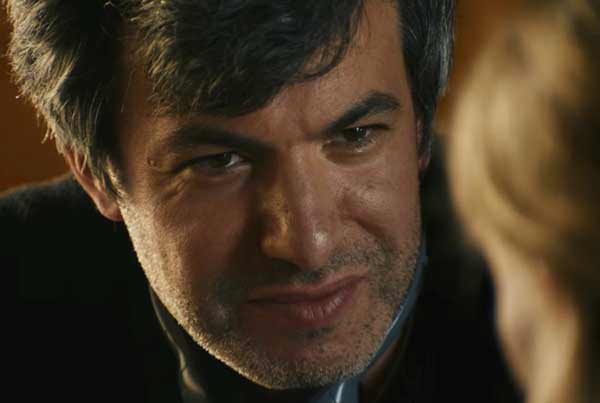
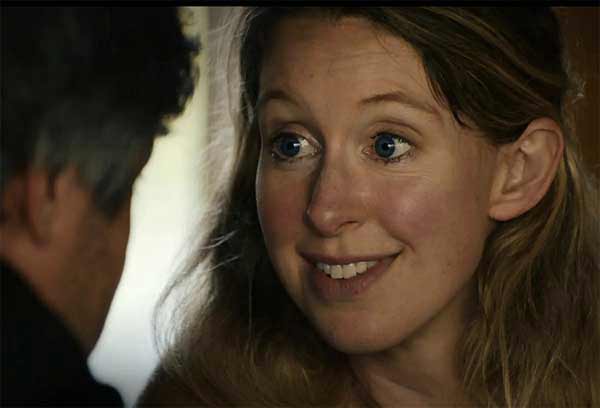
As for the filmmakers' intentions, they'd been looking for a project to work on together and went into the Holmes documentary unsure whether there was even a film to be made. Fielder went so far as to negotiate a kill-switch clause with A24, giving them the option to walk away if things didn't work out. Freed from the pressure of having to deliver a finished film, they could follow their curiosity wherever it led. At first, it's strange to see Fielder in the relatively straight-faced role of interviewer. We're so accustomed to the underlying absurdism of his television shows that it's hard not to keep waiting for the punch line. And to be fair, there are a few genuine laughs, as when he refers to Holmes's infamous blood-testing technology as the “scam machine,” or presents her with a joke disguise the night before she's due to report to prison, just in case she decides to go on the run. But once we accept Fielder in this new role, it's surprising not only what a good interviewer he is, asking pertinent, often lacerating questions with even more devastating follow-ups, but what a genuine movie star he turns out to be. The camera simply loves to watch him listen. Yes, Holmes, with her big-eyed stare and almost malevolent level of earnestness, is mesmerizing to look at. But her unwavering composure grows exhausting after a while. Whatever secrets she's hiding, she's not budging. It's Fielder's reactions that hold our interest: the way he absorbs what she's saying while searching for cracks in the foundation of her seemingly idyllic life. And the very real possibility that being this close to such a surreal presence has begun to affect how he sees the world. Something is clearly going on, not just with Holmes, but with Fielder, too. There are moments when the two sit across from each other, staring into each other's eyes, contemplating what's just been said or what they're about to say, that feel strangely like love scenes. But who's seducing whom? Meanwhile, Oppenheim and his camera crew watch from the shadows, giving us his trademark extreme close-ups of faces and seemingly random objects. Curious details drift by without comment, like the fact that Holmes' partner, Billy Evans, listens to podcasts at triple speed, or an extended full-frontal shot of Evans showering naked while Fielder looks on sheepishly. Most telling is a moment when Holmes is making breakfast and Evans steps in to take over the egg scrambling, snatching the bowl and whisk from her in a vaguely controlling fashion. And just as we start wondering what that was about, Fielder, as he does throughout the film, asks the question on everyone's mind: Why did you do that? The first part of the film is claustrophobic: one location, just three characters, mostly in close-up. When Holmes' parents show up half an hour in, there's a collective sigh of relief. It's here that one of the film's biggest shocks arrives. Discussing the downfall of Theranos, Fielder asks Holmes' father when he thinks everything went wrong. His answer, which I won't spoil here, produced an audible gasp and at least one “Oh my God” from the audience I saw it with. It's also here that Evans begins to reveal a less agreeable side. Just as the interview with Holmes's father gathers momentum, with Fielder apparently on the verge of extracting some genuine revelations, Evans steps in to bring it to an abrupt halt. It's the first suggestion that the seemingly affable partner may have more invested in controlling the narrative than he's letting on. In the second half of the film, after Holmes goes off to prison, Fielder gets to indulge in the kind of meta games he reveled in on his television shows. With Holmes no longer available, Fielder reconstructs from memory a series of scenes from before filming began, casting an actress to play Holmes. And which actress, you ask? Amanda Seyfried, who won an Emmy for playing Holmes in the Hulu miniseries “The Dropout.” Earlier in the film, Fielder shows Holmes “The Dropout,” watching her closely as she watches Seyfried portray her onscreen. Now we get to see Fielder show Seyfried the footage of Holmes watching Seyfried play Holmes. By this point, the layers of meta-ness have piled up so high we're positively giddy, like watching a gymnast stick a perfect landing. The thrill of seeing Fielder and Oppenheim pull off this moment of intertextual transcendence is the film's high point. And though it continues to delight and involve us, we're never quite as swept up again. At first, I considered this a structural flaw. The thing about watching a magician pull off a really good trick is that you immediately wonder what's coming next. How can he possibly top that? And though the revelations and jaw-dropping scenes keep coming, including a thrilling argument between Seyfried and Evans over her controversial response to the assassination of Charlie Kirk on Twitter (of course he’s a Charlie Kirk fan), I kept waiting for the big reveal. A clarifying scene in which Fielder, with Seyfried as his trusty new sidekick, finally gets to the bottom of whatever Holmes is hiding. Except we already know the essential facts. Holmes was convicted of fraud. That's not a matter of opinion. What's astonishing is that somehow, over the past three hours, looking at her through Fielder's eyes, we've begun to wonder if maybe, just maybe, we've gotten it all wrong. And this, I think, is the genius of what Fielder and Oppenheim have achieved, though it didn't really sink in until the day after I saw the film.
The fog of ambiguity hanging over the ending initially annoyed me. I wanted answers. But as I picked my way back through the meticulously constructed narrative, I realized that the directors had somehow managed to make us question the motives of every single person involved. In a recent interview, Lance Oppenheim described the experience of filming inside that beach house for 34 days. “It was like the laws of reality evaporated.” Nobody could agree on the meaning of anything. Even seemingly clear-cut moments, like Evans snatching the scrambled eggs away from Holmes, inspired wildly different interpretations. There was no shared understanding of what the crew was witnessing. And that uncertainty carries over to the film itself. Even now, I'm not quite sure what I saw or how I feel. I just know I can't wait to talk to people about it, to argue, to engage. In a culture increasingly determined to provide answers and leave nothing to the imagination, it's exhilarating to encounter a film that asks us to question our own certainty. I've seen how the trick is done. I know Holmes is guilty. And yet the magicians have played their hand so skillfully that I find myself doubting my own eyes. Bravo. IN THEATERS |
|
An LA-based playwright, JUSTIN TANNER has more than twenty produced plays to his credit, including Voice Lessons, Day Drinkers, Space Therapy, Wife Swappers, and Pot Mom, which received the PEN-West Award for Best Play. He has written for the TV shows Gilmore Girls, My So-Called Life and the short-lived Love Monkey. He wrote, directed and edited 88 episodes of the web series Ave 43, available on YouTube. Tanner is the current Playwright in Residence for the Rogue Machine Theatre in Hollywood, where his most recent play My Son the Playwright, of January of 2026, was met with rave reviews. Travis Michael Holder of the LA Drama Critics Circle wrote, "a phenomenal new achievement by local counter-culture hero Justin Tanner.”
|


To receive a free subscription to our Sunday Lounge! newsletter, Click Here
Have a suggestion? Send an email to the Editor, Click Here