I’LL STATE THAT I dislike definitions. Art, or art-making, is a maelstrom of individuated aspects that repudiate constraint, at least when the process is well cared for. Imputing an artist to any given location is diminutizing, at best. Regardless, every artist’s cultural environment has an osmotic effect, and observant individuals are intuitively inclined to distill what they absorb.
Taking any city pulling back its sinews for a glimpse at the bones confronts us with a set of services provided to its body, populous, or when searching for definition not provided. The essence of any metropolis lies in what it does and does not do. Its providence and systems, both macro and micro, are influenced by economic and ecological forces. In Vegas, the economy is service in its most astringent neoliberal modality, and the majority of the city lives in nearly exclusive support of that. Put differently, if you are not a service worker, entertainer, or financially flush, the City rarely shows up. Art, under these circumstances, is acceptable as long as it serves our industry.
Several initial factors must be stated to direct us in understanding.
First, Las Vegas is a celebrity. Despite its relatively small population and lack of even the most tertiary material industry, Las Vegas can match the hegemony levels of far more influential cities and locations. Speak its name almost anywhere in the world, and recognition will follow.
Second, this is a desert town. Desert living is necessarily hard. From the most windblown shack to our glinting, frenzied megalopolis, the matter at hand will always be scarcity. Thought here is generous finance, water, and consumables. Las Vegas shares very little of its largess with its citizens. Civic engagement, community, and cultural fortitude pump from a well dried by the searing indifference of its corporate superstructures’. Identity and consiousness more a flaw in the program than
Third, it is a tourist Mecca. It has 40 million people passing through it every year (like your mom). In response to that influx, it’s a hyper-adaptive, even progressive, bending to the tilt of populist novelty. Lacking attractive natural wonders or laudable history, Las Vegas is primarily observed through passing impressions and novelty, forced to coax its audience repeatedly to maintain its status.
Finally, there’s the reality that Las Vegas is an arts haven. Not in the sophisticated, bustling Manner of Manhattan, or with the sweltering sensualism of New Orleans, but in its own cloying way through the solicitous production of spectacle. Vegas hosts innumerable aspects of materiality, design, and a form of showmanship that is rarely collected so thoroughly elsewhere.
The cocktail waitress grifting a smile for extra tips. The lounge pianist executing a foot-on-the-keyboard trick, playing a top ten hit. The gawking, stage-clown pratfalling their way into a laugh, the line cook blanching fingerling potatoes to pair with prime rib. The foam carving fabricator building a massive jackpot sign for a slot tournament. The topless dancer glittering her way through a purple-lit stage. The late-career superstar settling into a months-long residency. Artists all.
So we then ask how these essential factors shape Las Vegas artists. Given that art making in this century typically includes intense cultural commentary, what artwork arises from a culture geared almost exclusively towards spectacle and seduction, in the service of extraction?
Examples are in order.
Let’s begin with the bigger fish.
There are interpreters from outside the city who are relevant in this conversation. Jenny Holzer’s 1986 piece Caesar’s Palace, the casino’s kiosk blasting “Protect me from what I want” in LED light, is as Vegas, a piece of art that’s been allowed to exist. David Lynch’s interpretation of our city as an absurdist, hollow, flatland in The Return is worth more words than I can write here. Ugo Rondinone’s Seven Magic Mountains might have something to say, but I’m too busy listening to Little Jimmy Scott’s version of “Nothing Compares 2U” to care.
Tim Bavington’s striking formalist musical compositions come color fields, are, to pull a contextually ambiguous quote from David Pagel, “just the right mix of freedom and necessity, will and determinism, order and randomness, work and play, rigor and recklessness.”
Sounds a lot like a town I know. Bavington’s work, sans critique, is the byproduct of the instruction of art critic and public intellectual David Hickey. He is of a University of Nevada, Las Vegas MFA cohort that includes the exceptional Sush Machida, whose bubblegum interpretations of traditional Japanese aesthetics I adore, and David Ryan, a formalist master of abstraction whose work winks slyly at Vegas signage. Of this group, a common ascetic sensibility of aggregating soft line, bright pigment, and mediated space reflects the city in which they honed themselves.
Hickey’s ideological understanding of the city and his guidance to a crop of young artists at the turn of the century paid great dividends toward the notion of a “Las Vegas artist” and its school of thinking. The aesthetic becomes the concept. The concept holds the notion of a neon metropolis up for analysis. The work of the above-mentioned artists and many others who received Hickey’s pedagogy has a definitive ripple effect on the presentation of Las Vegas artists moving forward.
Justin Favela (a protégé of David Ryan’s) provides an excellent counterpoint to the soft lines and tones of the Hickeyites. Favela is, as I compose this article, our most prominent artistic export. His sculptural practice of producing flashy, tongue-in-cheek piñatas that commenton identity, place, and the absurdity of Vegas’s vision of the American dream (the one Hunter S Thompson so dubiously searched for in “Fear and Loathing”) fringing the jagged edges of living in a service-industry city that feeds off of blue-collar immigrant labor.
Like Bavington, Favela comes with his own cohort of equally exceptional artists— a diverse coalition of UNLV BFA queerdos each possessing a savage absurdism with no celebrity tutor in sight. Mikayla Whitmore’s blazing photographic work, isolating the minutiae that surround and lives within the city, cribbing commercial techniques to concretize the city’s (and the desert’s) glinting precarity. Lance Smith’s soft-edged renderings of Black interiority and queer displacement resonate with the town’s oppressive transience, sandstorms of emotion rolling through glass towers, while Krystal Ramirez’s towering textual work chips merrily away at a culture that perfected the neon sign.
Favela’s primary medium itself is an aspect summation of Las Vegas consciousness. A piñata is as much a subject of destruction as a $500-million casino and all the hopes, dreams, lust, and devastation that occurred within it. A temple to decadence caved in with a few short blows. All the candy long since spilt out into bourbon glasses, condoms, and corporate pockets. Something in the city’s consistent institutional erasure plays at the heart of its artists.
From here, we find the pond’s smaller life forms. Most of them are less lauded, often conceptually driven, and intellectually divergent. Artists with day jobs, local hustlers, and stray dogs (or dog-fish, am I fucking this metaphor, oh well) that may just bite.
Admirable individuals like muralist Jerry Misko, whose diligently organized, graphically oriented, standardized style abstracts the architecture and signage of the city, slicing thin portions of the whole off to inspect their beauty. He’s two parts technician to one part used car salesman. Misko embodies the scrappy local hustler ethos while building a vernacular of our vernacular.
Eric Vozzola is another cherished muralist who has developed a refreshing take on Southwest aesthetics. His massive paintings dance across the eye on public thoroughfares, creating a complex codex of familiar images composed in bright, exciting arrays. His uniquely Las Vegan take on the desert sunsets and wilderness is irrefutably ours.
Certainly, JW Caldwell is a definitive Vegas artist, cigarette in one hand, paintbrush in another, and cold beer waiting for him at one of the city’s nicotine-stained dive bars once he finishes his latest text-based work. Weighty, clever phrases paired with deceptively simple renderings of dinosaurs or Paleolithic megafauna. Postcards to send to loved ones while touring the apocalypse. His sharp-toothed cynicism gnashes away at our future ghost town.
Consider Alexander Sky—downtown mainstay and all-around good-time guy. His chaotic street art is as culturally engaged as that of any creative in the scene. Sky keeps it grimy, a crucial ingredient in the Vegas soup that identifies the city away from its Southwest cousins. He produces heart-on-sleeve images that live in the funk of a town built on g-strings and liquor bottles, apersonification of our go-easy attitude.
Or Ika Pearl, and their use of common objects, skillful drawings, and writing midwifing mixed-media mutant babies, the whiff of atomic radiation passing through, simply to inform you that a diaper change is in order. Pearl holds the intimate with dirt under their fingers and tremulous hands, shielding it from the onslaught of fabricated identity.
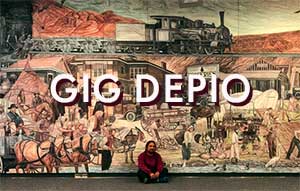
In the realm of representational painting that captures our city’s visual lexicon, Gig Depio, Brian Martinez, Sam Ganados, and Q’shaundra James take Neoclassical and pop-surrealist perspectives and tell our city its story back to it.
Depio’s massive canvases land just shy of Rivera-scale social dramas. He portrays the heaving thrust of a culture without completion, our history and tumult piled on thick as his paint, directing all vectors toward secreted discourses.
Martinez’s frenzy of wild psychedelic luchadores, Chicano touchstones, and Americana is a bilingual discourse with spectacle itself. His renderings, in all of their skill and nuance, are incapable of existing without a touch of Vegas kitsch.
Ganados collects everyday social scenes of youthful frivolity (a core component of our city’s appeal) and embeds the viewer halfway into a blunt rotation at the skate park. Her proficiency in depicting the fray of bodies in action, frivolity, and the darker, more emotive events of social life in a little Southwest town with a big name morphs anyplace-USA into our place.
James renders more liminal states and environments. Her portraits of people and places highlight a domesticity that is often overlooked. She paints sprawling, low-rise housing, spare living rooms, and images of people clinging to popular iconography as humanizing fetishes, holding the line between desperation, domesticity, and pop culture in a way that can only be discovered in this city.
The assemblage crowd on many levels speaks to the truest nature of the city. Sifting through detritus provided by infinite, hot inebriated evenings, the refuse left by hyper-capitalist consumption, poker felt from a gambler’s lament. DK Sole and QuindoMiller take the flotsam of our city, preserving it.
Sole, a land artist working with the materials the land provides, creates miniature takes on monumental sculptures, out of bottle caps, bits of string, and wire. They are a catalogue of the liminal, the things we forget, we have forgotten.
Miller takes trimmings and samples from their lived experience and places them in terrariums that capture wet desert washes, wind-swept plateaus, and Micronesian living rooms on karaoke night—theatrical sets containing real-life moments, scenes from a hotel lobby in their mind.
Performance artists round out our mix.
In truth, Vegas is one long, hideous, sprawling performance piece. Your bartender, waiter, poker dealer, valet, and stripper would tell you that if you took any time to listen. The performative nature of a town that’s “always on” leads to persona exhaustion. Adriana Chavez, Heidi Rider, Karla Lagunas, and Ali Fathollahi are prime exemplars.
Chavez brings bluster and machismo to the fore with Juan Chico, her alter ego interpretation of Latino masculinity. Based in the body She silently prods the farce of male identity while excavating the artifacts of Indigenous and colonial history that it contains. Chavez gives comically harsh commentary on the individuals Las Vegas thrives on.
Rider trots out the sad clown. Her performance work dwells in the exhaustion from the infinite night of crowd-pleasing. Weeping, through a moment’s respite between curtain calls. Her brilliance lies in small gestures and muffled screams. An entertainer threadbare from excessive exposure to audience. Glaring at our collective folly from the spotlight.
Lagunas’ work lives in precarity. Her paintings and performances reach for the impossible, as do so many doe-eyed dreamers who migrate to our town. Art made ferial by utopian dreaming and the identity crisis that follows. Inevitably, she embodies the experiences of individuals provided just enough rope to hang themselves with. Her exposition of our collective dissatisfaction burns going down, a shot with no chaser.
Fathollahi’s hyper-cerebral work is survival-oriented, based on the need to play Swiss Army knife in the pocket of a place that perceives its patrons as marks and its citizens as servants. His performance work is a product of the dark levity that’s born through forced migration and the persistent manipulation of American identity.
An outlier here or possibly the core of this thing. When looking for what can be defined as a Las Vegas artist. In a transient city where most neighbors are strangers, that often fails in the most basic adequacy of cultural infrastructure, space, and community, are high-value commodities. Artists who will-together social structures and cultural spaces are not as ubiquitous as they may be in Chicago, New York, or LA, but these individuals and groups set the tone for Vegas’s cultural identity.
Chase Mc Curdy is a historic west side artist, so dedicated to the underserved black community that lives in the shadow of downtown Las Vegas, that I hesitate to call him a Las Vegas artist. His vision for a little-known and less-loved section of the city transcends the excellence of his personal practice. Chase’s 33g is an artspace, and a gathering place for creative experimentation, cultural education, and social change.
Fawn Douglas’ Nuwu Art + Activism Studios provides working artists with studios, a gallery, and a gathering spot. Add to that her activism, powerful art practice, Paiute lineage, and dedication to nourishing the indigenous community the land was stolen from, and you are looking at an artist whose methodology predates the colonial name Las Vegas.
Then there’s Wendy Kveck, a Las Vegas arts grand dame if there’s ever been one. Her intense feminist work is nearly dwarfed by her persistent role as organizer, curator, and place maker (albeit digital). Her long-form catalogue of the city’s transient arts culture through her website Couch in the Desert, lobbying for arts funding, and guidance for artists in all manner of creative pursuits as an educator, places her as one of our great social engineers.
In the sphere of the communal arts collectives, the trend is long-standing. Many hands make short work, and The Contemporary Arts Center, Lazervida, Black Bird Studios, The Katherine Gianaclis Park for the Arts, and The Nevada Institute of Contemporary Arts, all defunct organizations, remain major contributors to what defines an artist in this community.
Recently, the city-breaking, Scrambled Eggs as an art collective has provided a diverse, raucous vision for contemporary art that is currently setting the pace for Vegas. These events and exhibitions are the most forward-thinking, diverse, and stunning showings on par with anything you might find in other towns. Organised by a star-studded cast of brilliant young art makers so large and excellent that they deserve a story that cannot be fleshed out here.
If we look long and hard at the praxis of establishing arts havens as the art form it is, Left of Center Gallery, helmed by artist Vicki Richardson, takes the cake. Left of Center’s thirty-year legacy of showcasing local talent in an out-of-the-way neighborhood bordering North Las Vegas is the most consistent and impactful I can think of. The founders and maintainers of Left of Center, Harold Bradford an incredible draftsman and painter who art directed at the city’s neon sign giant, Yesco, for decades, Sylvester Collier, whose soulful mark making resonates volumes of Black life, and Richardson’s unwavering determination to bring art and arts education to the valley may be more stabilizing than any effort to date.
If you haven’t been included, it’s for several reasons: I don’t know your work well enough, or you are more international, national, West Coast, or even Nevadan to be summed up in shorthand. I’m not getting paid enough (am I getting paid for this?) to mention every excellent Vegas visionary and how their work relates to our staggeringly unfair city. I genuinely forgot, or I don’t like your art (yes, you Pretty Done). Regardless, I question if we can find an individual artist or group whose work is within the realm of defining a “Las Vegas” artist (maybe it’s me you paunce, you ever think about that? No, you only think about yourself!). There are too many moving parts to this machine; all we can do is stand close and listen to it hum.
From a panoptic perspective, the artists in Las Vegas are those set about its dismantling, prying from different angles to show us how the engine works.
The thing is… everywhere is Las Vegas now. We as a culture YOLOing towards the precipice of societal collapse. Frivolous mass marketing campaigns, service as key economic driver, flashy games, facile celebrity, facade as artifact, spectacle as sacred, twenty-five-dollar burger and fries, the last vestiges of a culture in decline. The artist’s obligation to report upon these and so many other modern atrocities that began in Sin City is now a broader subject. Vegas was once the rare metropolitan area where conmen could openly pose as leaders and mobsters could register as businessmen, something that is now just our way of life.
Las Vegas artists possess the same qualities as artists throughout the world. Like all desert dwellers, they are scrappy and resourceful. Earnest yet performative, like any survivor of a service-based economy. Diligent and technically adept in the way one must be to surf a media frenzy. Acutely aware of historical erasure, as any individual accustomed to institutional collapse becomes. The question I fear is not what defines a Las Vegas artist, but how much of Las Vegas defines the broader culture, and when that question is answered, the one that remains is why aren’t Las Vegas artists more prominent in the conversation?

BRENT HOLMES
Instagram, Click Here
Holmes is a artist, curator, and cultural animator whose work pushes theviewer and the limits of the possible. The son of an entertainer, Holmes utilizes art and the written word for story-telling that is rooted in African American history, struggle, and brilliance. Holmes has exhibited his artwork locally, nationally, and internationally, including at Light & Space Contemporary (Manila, Philippines), the Markeaton street gallery in Derby England, The Momentary art museum in Bentonville, Arkansas, the Torrance Art Museum in California, the Tacoma Museum of Art in Tacoma WA, the Nevada Museum of Art Reno, and the Marjorie Barrick Museum of Art, where his work is part of the permanent collection at the University of Nevada, Las Vegas. Holmes has won accolades for his writing and art criticism for Double Scoop Nevada, and has been published by the Believer, New York Times Magazine, and HyperAllergic. He is the host of Neon Hum Medias’ Spectacle: Las Vegas a twelve part series on the city’s history as a representation of American cultural values.
------------------------------
Artist and writer GORDY GRUNDY is the Editor-in-Chief of Art Report Today
Back to Main Page |
|